
Multiple reports have confirmed a significant share of AI-issued road safety fines in Western Australia have been withdrawn, with more than $1 million in penalties cancelled since the system was introduced.
WA’s AI-assisted road safety cameras have had more than $1 million in fines withdrawn within six months of operation, prompting ongoing scrutiny of the system’s accuracy and enforcement approach. It’s an issue that also impacts 4×4 and touring drivers who regularly carry passengers, gear and families on long regional trips.
Introduced in October last year, the technology uses artificial intelligence to detect potential seatbelt and mobile phone offences. Since rollout, authorities have issued more than 53,000 seatbelt-related infringements across the state.
Of those penalties, around 2,000 have been revoked following internal review by the Department of Transport, equating to roughly $1.1 million in cancelled fines.
Data shows 3,381 motorists formally challenged their infringements between October 8 and April 17. Around 60 per cent of those reviews resulted in fines being withdrawn, with 2,043 notices ultimately overturned. In total, the enforcement program has generated more than $29 million in penalties, averaging close to 300 infringements per day over the period. Some motorists also reported receiving multiple fines in short succession, limiting the opportunity to correct alleged behaviour before further penalties were issued.
A large portion of infringements relate to passengers – particularly children – being incorrectly restrained. The issue has relevance for touring and 4×4 drivers, who often travel long distances with rear-seat occupants in regional and remote conditions. Some motorists argue they cannot safely intervene while driving, yet still face automated penalties.
Critics say the system places the burden on drivers to dispute fines after the fact, with many only succeeding after formal review or escalation. Authorities have acknowledged delays in processing reviews, advising motorists that responses may take up to 20 business days due to increased workload.
The issue escalated earlier this year when the Road Safety Commission launched a formal review after reports the cameras were generating more than $1 million in fines per week.
In WA, seatbelt infringements start at $550, while mobile phone offences are $500. Penalties vary nationally, with Queensland issuing fines above $1200 and four demerit points, and Victoria applying $395 fines and three demerit points.
Utes remain a cornerstone of the Australian vehicle market, valued for towing, payload and off-road ability. But with rising running costs, fuel efficiency has become just as important as capability for many buyers.
While real-world consumption varies depending on load, accessories, terrain and driving style, most modern diesel dual-cab 4×4 utes cluster within a relatively tight efficiency window. In today’s market, around 7.0-8.5L/100km (ADR combined) is generally considered fuel-efficient for this segment.
These figures are based on the Australian Design Rules (ADR) combined-cycle testing procedure, which measures fuel consumption under controlled laboratory conditions designed to reflect a mix of urban and highway driving. However, real-world figures can vary significantly, particularly when vehicles are fitted with accessories such as bull bars, roof racks, larger tyres, or when used in sustained off-road or towing conditions.
All figures below refer to ADR combined-cycle fuel consumption for the most efficient diesel variants available in Australia, in no particular order.
Why plug-in hybrid and electric utes are excluded
This comparison focuses on conventional diesel utes using comparable ADR combined-cycle figures. Plug-in hybrid and electric utes have been excluded because their efficiency results are not directly comparable under standard usage conditions.
Models such as the Ford Ranger PHEV and BYD Shark can achieve very low official consumption figures when regularly charged, often under 3.0L/100km. However, real-world fuel use varies significantly depending on charging habits and battery depletion, and can overlap with efficient diesel utes once operating outside of charge-assist conditions. For this reason, they are best assessed separately within electrified or hybrid-focused comparisons.
Isuzu D-MAX and Mazda BT-50 2.2-litre
- ADR: 6.6L/100km
The Isuzu D-MAX and Mazda BT-50 are both now available in Australia with a 2.2-litre four-cylinder turbo-diesel (RZ4F-TC), paired with either a six-speed manual or six-speed automatic and part-time 4×4 across selected variants.
In both applications, the engine produces 120kW and 400Nm, positioning it as the efficiency-focused alternative to the larger 3.0-litre diesel. It delivers strong low-end torque for everyday driving while prioritising lower fuel consumption and reduced running costs over outright towing capacity.
In the D-MAX, the 2.2-litre engine is tuned for durability and efficiency across urban, highway and light-load use, with a clear emphasis on predictable operating costs and compliance with tighter emissions requirements. It represents the most fuel-efficient engine in the current D-Max lineup.
In the Mazda BT-50, the same mechanical package is carried over but tuned with a stronger focus on refinement and road comfort. This results in quieter operation and a more road-biased driving character, while maintaining broadly similar efficiency outcomes to the D-Max in real-world use.
Ford Ranger 2.0-litre
- ADR: 6.9-7.9L/100km
The Ford Ranger 2.0-litre bi-turbo diesel, available across XLT, Sport and Wildtrak variants, is one of the most efficient full-size ute powertrains in Australia.
Its twin-turbo diesel setup allows a smaller-capacity engine to deliver strong low-end torque while maintaining strong efficiency at highway speeds. The 10-speed automatic transmission helps keep engine revs low during steady cruising, contributing to its competitive ADR figures.
In real-world use, the 2.0-litre Ranger is most efficient in light- to medium-load driving and highway touring. Higher-spec variants fitted with the 3.0-litre V6 diesel prioritise towing and performance, with noticeably higher fuel consumption.
Toyota HiLux 2.8-litre
- ADR: 7.1-8.0L/100km
The Toyota HiLux is powered by a 2.8-litre four-cylinder turbo-diesel (1GD-FTV) across SR, SR5, Rogue and GR Sport variants, paired with either a six-speed manual or six-speed automatic.
In current specification, it produces 150kW and 500Nm with the automatic transmission (420Nm with the manual), delivering strong low-end pulling power suited to towing and load carrying.
The engine is tuned for durability and broad torque delivery rather than outright efficiency gains, which is reflected in its mid-range ADR consumption figures. Fuel use remains relatively stable across mixed driving conditions, including when carrying loads, although heavier 4×4 dual-cab automatic variants typically sit toward the upper end of the range.
Volkswagen Amarok 2.0-litre
- ADR: 7.2-8.0L/100km
The Volkswagen Amarok is offered with a 2.0-litre four-cylinder TDI turbo-diesel in Life, Style and PanAmericana variants, paired with a 10-speed automatic and full-time 4MOTION all-wheel drive.
In Australian specification, this engine produces up to 154kW and 500Nm, matching its Ford Ranger counterpart but with model-specific calibration.
The powertrain is tuned for smooth on-road performance and relaxed cruising, with strong mid-range torque delivered at low revs. Fuel consumption is most efficient during highway driving, while remaining broadly in line with other dual-cab utes in mixed-use conditions.
Mitsubishi Triton 2.4-litre
- ADR: 7.4-7.7L/100km
The Mitsubishi Triton is powered by a 2.4-litre four-cylinder turbo-diesel (4N16) across GLX, GLS and GSR variants, paired with either a six-speed manual or six-speed automatic and Mitsubishi’s Super Select 4WD system.
In current specification, it produces up to 150kW and 470Nm, delivering a strong spread of usable torque for everyday driving. Its relatively low kerb weight, combined with efficiency-focused engine and transmission tuning, helps keep fuel consumption competitive across urban, regional and mixed conditions. While capable, the Triton prioritises efficiency and drivability over outright towing performance compared with some larger-capacity rivals.
Nissan Navara 2.3-litre
- ADR: 7.2-8.1L/100km
The Nissan Navara is powered by a 2.3-litre four-cylinder twin-turbo diesel (YS23) in variants such as SL and Pro-4X, paired with either a six-speed manual or seven-speed automatic.
In Australian specification, it produces up to 140kW and 450Nm, with the twin-turbo setup designed to deliver strong low-end response and improved mid-range torque.
The engine is tuned to balance drivability and efficiency, with fuel consumption remaining competitive across mixed driving conditions. Efficiency is strongest in light- to moderate-load use, particularly during steady highway driving where the engine operates in its optimal range.
Isuzu D-MAX and Mazda BT-50 3.0-litre
ADR: 7.0-8.0L/100km (BT-50) | 7.4-8.0L/100km (D-MAX)
The Isuzu D-MAX and Mazda BT-50 are closely related dual-cab utes that share the same 3.0-litre four-cylinder turbo-diesel (4JJ3-TCX), paired with either a six-speed manual or six-speed automatic transmission and part-time 4×4.
In both applications, the engine produces 140kW and 450Nm, delivering strong low-end torque suited to towing, load carrying and off-road use. The calibration prioritises durability and consistent performance over peak output, contributing to steady and predictable fuel consumption across a wide range of conditions.
The D-MAX is tuned with a stronger focus on robustness and long-term reliability, with conservative engine and drivetrain mapping designed to support consistent efficiency under load, including commercial and regional use. Lower-grade variants are also offered with a 1.9-litre turbo-diesel (110kW and 350Nm) in some markets and previous specifications, prioritising lower running costs and improved efficiency in lighter-duty applications.
The BT-50 uses the same core mechanical package but is tuned more heavily toward refinement and road comfort, resulting in quieter operation and a more road-biased driving character. Despite this, fuel consumption remains broadly similar between the two models, with differences in efficiency being marginal and largely dependent on specification, accessories and driving conditions rather than mechanical differences.
Australia’s ute market is now defined by tight efficiency clustering rather than wide separation between models. Most modern diesel dual-cab 4×4 utes fall within a 7.0-8.5L/100km ADR combined range, with differences increasingly driven by engine size, weight and drivetrain tuning rather than fundamental efficiency gaps.
Smaller-capacity engines such as the Ford Ranger 2.0-litre bi-turbo and Mitsubishi Triton 2.4-litre tend to sit at the more efficient end of the spectrum, while larger 3.0-litre diesels prioritise towing capability and durability with only a modest fuel consumption trade-off.
Part 1: Prado GX in the shed for a couple of months
At the launch of the Prado 250 late in 2025, I came away from the drive in Kakadu NP saying that, for my money, the base-model GX grade represented the best value.
I’m not one of those base-model fanboys who want everything on black steelies with minimal features; there are plenty of luxe items I enjoy in a new vehicle. But, as one of only two models in the new Prado range to offer a five-seat configuration – the other being the high-specced Altitude model – I felt that the GX was the best package.
Following consumer backlash regarding the poor packaging of the seven-seat Prados, Toyota conceded and added a five-seat GXL to the model range, and this, for me, could be the best model. So when Toyota offered us a GX for a three-month test, we jumped at the chance to get back into the entry-level Prado.
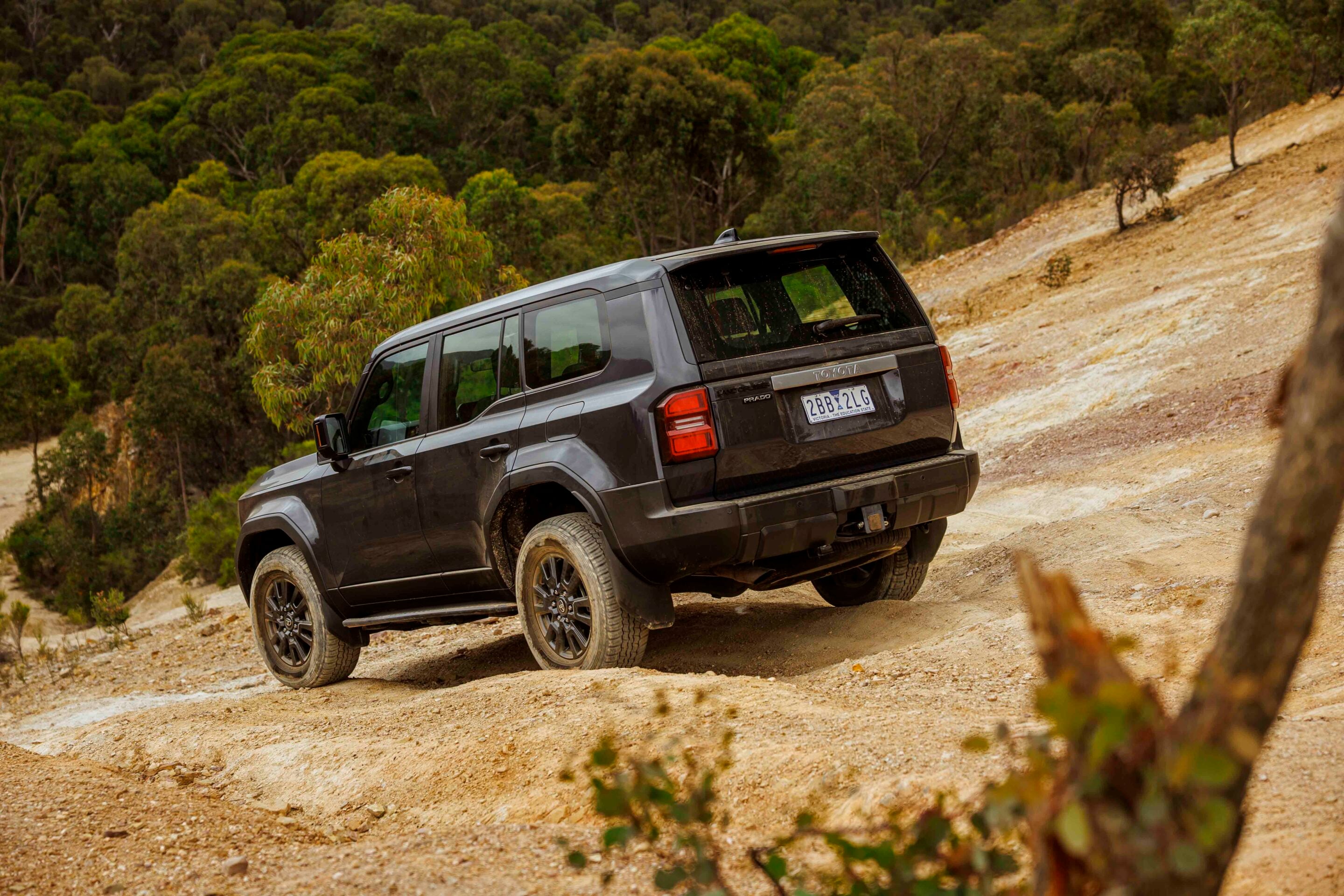
The vehicle we have is a 2024-badged GX and was possibly one of the vehicles from that original launch program. It has 16,000km on the clock and has its fair share of bush pinstripes and evidence of a life well lived.
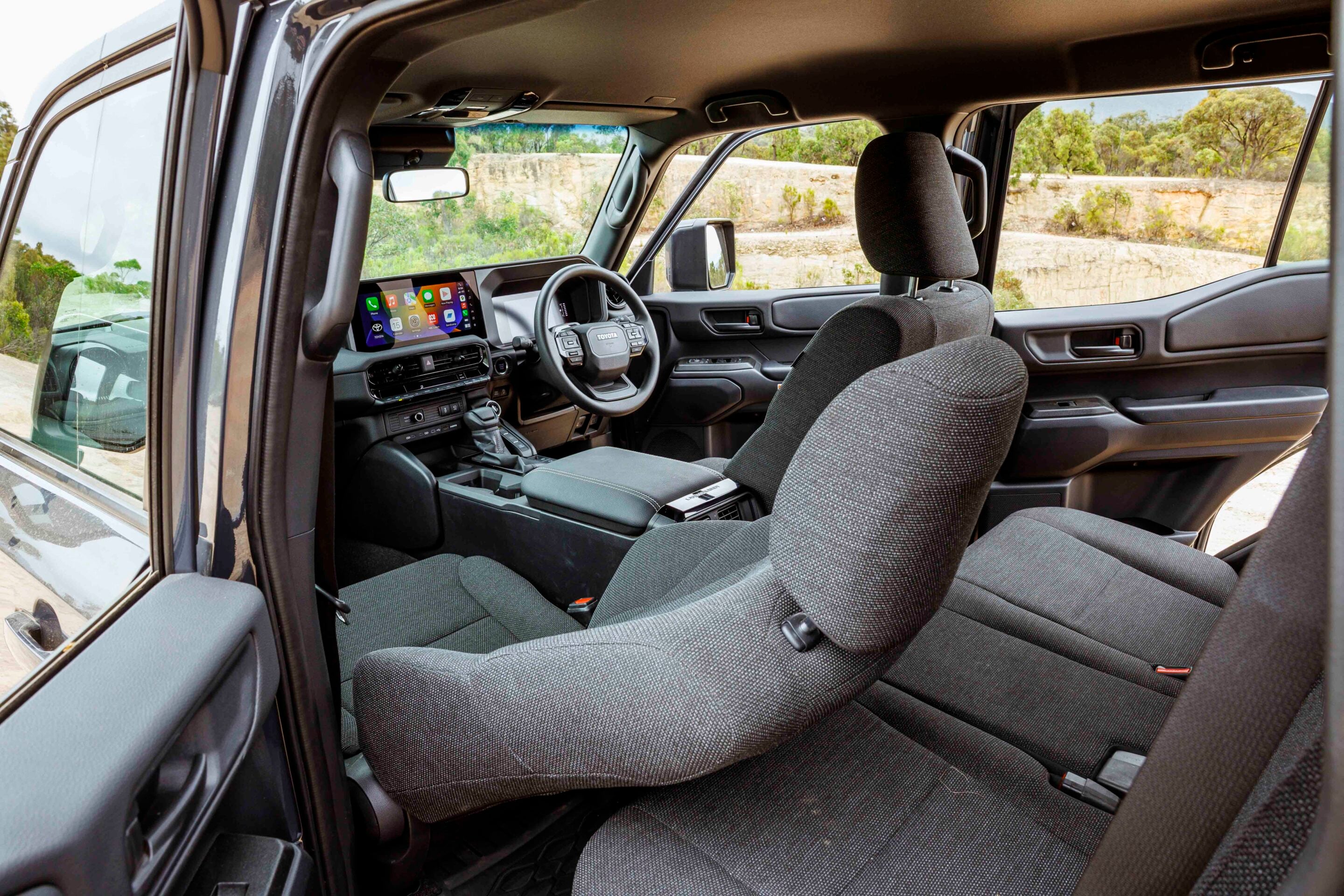
The GX comes with almost all the features you could want and nothing you can’t live without. Inside, it has cloth-covered seats, a 12.3-inch multimedia screen compatible with wireless Apple CarPlay and Android Auto, Bluetooth connectivity, cloud-based built-in sat-nav, dual-zone climate control, and a decent sound system. The cabin is big and comfortable and includes all the modern ADAS and safety features. The only thing I think it’s missing is a tyre pressure monitor, as this is only offered in the higher-grade models.
The 500Nm 2.8-litre engine and eight-speed auto combination provide plenty of power for highway driving and are smooth and refined around town. The large glasshouse offers great vision for both the driver and passengers, and the lack of third-row seating means there’s heaps of space in the cargo area. The cargo space is still compromised by the hybrid system battery under the floor, but nowhere near as much as it is in the seven-seat models.
Our first jobs for the Prado were a couple of comparative road tests, one of which was against its main rival, the Ford Everest. The other test you’ll need to wait a little longer to read, but it’s safe to say that the Prado impressed our drivers on both occasions.
Aside from being my daily driver, the Prado has been used as a workhorse by our photographers and videographers, who really appreciated the capacity of the cargo area and the general ease of use and drivability. This is the biggest Prado ever, and the amount of space in the front and rear seats has also been noted by those using the vehicle. It has the same wheelbase as a 300 Series LandCruiser and is bigger inside than an 80 Series.
Its off-road performance has been great on the road tests, thanks mainly to Toyota’s responsive electronic traction control system, backed up by good axle articulation and the clever Crawl Control system. That said, the first thing we’d add with the money saved by buying the GX over the more expensive grades is a set of front and rear locking differentials for the best off-road traction.
- Kilometres when it arrived: 16,802km
- Average fuel: 9.2L/100km
Part 2: Time is up with the versatile yet simple wagon
Our time with the Prado 250 Series GX came to an end all too soon, as the base-model Toyota 4×4 wagon had become such a useful vehicle for whatever we threw at it.
Supporting photo shoots with the 4X4 Australia team, weekend escapes, hauling gear and general daily-driver duties, the Prado did it all with ease. It was that daily-driver aspect I particularly enjoyed, as it’s such an easy vehicle to live with. It’s simple to jump in and out of for a quick trip down the street, yet just as accommodating when loading it up with gear.
After folding the second row of seats down to carry larger items, I left it in that configuration as it made it simple to throw a pushbike in the back – and I don’t often need a rear seat. On one weekend, I was able to load four bikes into the cargo area, making the Prado a genuinely practical load hauler.
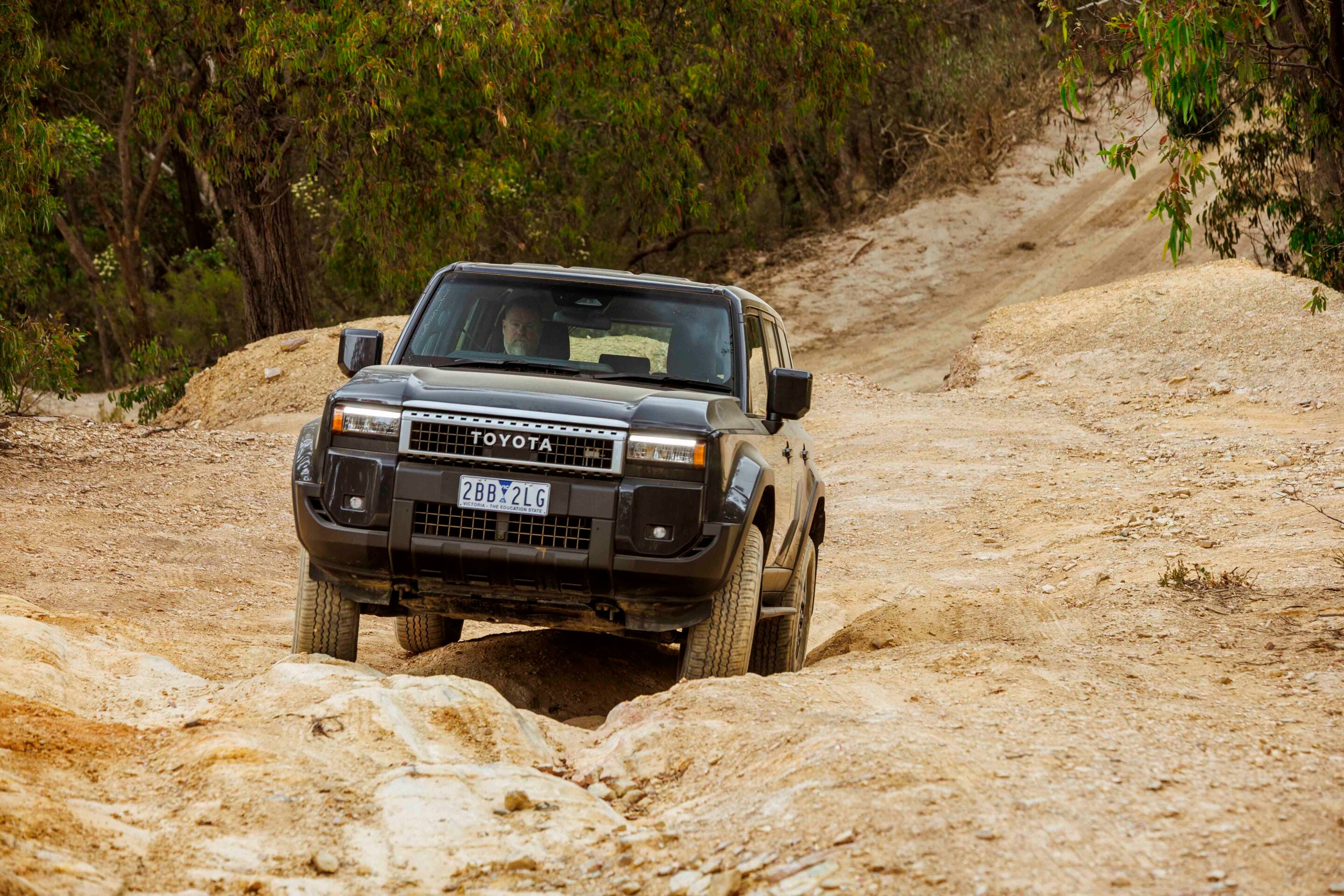
The fact that the 250 Series is bigger inside than any previous Prado is appreciated not just for carrying goods, but also for front-seat passenger comfort. The driver’s space is roomy and comfortable, with all controls easily at hand. The large, flat windscreen offers a great view of the road ahead, while the side windows provide excellent visibility around the vehicle.
Interestingly, some 250 Series owners have found the large, flat windscreen more prone to stone damage than previous Toyota 4x4s, although we didn’t experience that issue. We did, however, have a slow leak from one of the front tyres, which became evident while driving. It was manageable over the final week with the vehicle, but it would have been easier to identify and monitor if the GX was fitted with a tyre pressure monitoring system (TPMS), which is reserved for higher grades.
Another minor annoyance is the AdBlue warning displayed on the digital dash, which illuminates a low-level warning despite indicating there is still around 2000km of range remaining. While useful on long trips, I found the constant warning symbol distracting in everyday driving.
These are minor gripes in what is otherwise an exceptionally well-sorted package from Toyota. Even in this lower specification, it has most of what you need and little you’d miss. The exception is the 48V hybrid system, which offers modest gains in performance and fuel efficiency but is mounted in the rear, limiting load space and the ability to fit larger auxiliary fuel tanks.
The Prado, in any grade, is a great platform for building a capable touring 4×4, but the GX in particular is a true blank canvas. Just take a look at the Razed Products Prado featured on the cover of our April issue.
- Kilometres this month: 662km
- Average fuel: 9.0L/100km
Australia’s ute market is heading into a busy period from 2026 onwards, with a steady influx of new 4×4 models joining the segment across both established brands and new entrants.
Much of the focus is shifting toward plug-in hybrid and electric variants, alongside updated diesel offerings that continue to serve traditional work and touring buyers. From familiar nameplates moving into electrification to all-new global utes entering the local market, the next few years will broaden choice across capability, efficiency and technology without moving away from core 4×4 functionality.
JUMP AHEAD
- Mitsubishi Triton Raider
- Toyota HiLux BEV
- JAC Hunter PHEV
- Chery KP31
- Nissan Frontier Pro PHEV
- VW Amarok W600
- LDV eTerron9
- Chevrolet Silverado EV
- Rivian R1T
- Riddara RD6
- Isuzu D-MAX EV
- JAC T9 EV
- Ford F-150 Lightning EREV
- BYD Shark 2.0
- Ford Ranger Super Duty Pick-Up and XLT
- KGM Musso
- Mahindra Pik-Up
Mitsubishi Triton Raider: May 2026
The new Triton Raider arrives as the flagship of Mitsubishi’s ute line-up, bringing a focused mix of suspension upgrades and rugged styling tweaks.
Developed in collaboration with Premcar, the Raider’s key enhancement is a revised suspension package designed to improve ride and control in harsh conditions. Up front, new shock absorbers feature internal rebound springs – technology recently seen on the latest Navara – aimed at better managing compression and delivering more composed handling off-road. Paired with Bridgestone all-terrain tyres on ROH ‘Assault’ alloy wheels, the setup also lifts ride height by 25mm and widens the track by 20mm.
Beyond the mechanical changes, the Raider leans into a tougher visual identity, with unique badging, a heavy-duty bash plate, and sports and side protection bars accented with red highlights. Based on the already well-specced Triton GSR, it retains the 2.4-litre twin-turbo diesel producing 150kW and 470Nm, matched to a six-speed auto and Mitsubishi’s Super Select dual-range 4×4 system. Set to land in Australian showrooms from May 2026, pricing is still to be confirmed.
Toyota HiLux BEV: May 2026
Toyota is set to shake up the workhorse segment with the arrival of its first battery-electric HiLux, the HiLux BEV, due in Australian showrooms from May 2026.
Offered exclusively as a double-cab, the range opens with the SR cab-chassis and SR pick-up, topping out with the SR5, all powered by a dual-motor all-wheel-drive system. Drawing energy from a 59.2kWh battery, outputs are rated at a combined 144kW and 468Nm, while Toyota’s Multi-Terrain Select system delivers six drive modes to maintain off-road capability. Tested extensively in harsh Australian conditions, Toyota claims the BEV is engineered to handle the same demanding workloads as its diesel counterpart.
Charging capability includes 150kW DC fast charging – delivering a 10 to 80 per cent top-up in around 30 minutes – and 10kW AC charging, with a full charge taking approximately 6.5 hours. Driving range is quoted at up to 315km for pick-up variants, dropping to 245km for the cab-chassis, while towing capacity is rated at 2000kg. The BEV also features reinforced suspension, regenerative braking and subtle exterior tweaks including a closed-off grille and aero-focused wheels.
Inside, it mirrors the practicality of the standard HiLux, with a 12.3-inch infotainment system, wireless smartphone connectivity and a usable 1500W inverter, while the SR5 adds a more premium finish with leather-accented trim, heated seats and upgraded audio. Safety is covered by Toyota Safety Sense, and buyers will also receive a complimentary home wallbox charger for added convenience.
JAC Hunter PHEV: Mid-2026
The JAC Hunter PHEV is shaping up as a high-output entrant in Australia’s hybrid ute segment, built around a plug-in hybrid system that prioritises outright performance.
Early specifications point to a turbocharged petrol engine paired with dual electric motors, delivering combined outputs of around 385kW and up to 1000Nm. This setup suggests a dual-motor AWD configuration rather than a purely mechanical 4×4 system.
Energy is supplied by a high-capacity lithium-ion battery (31.2kWh), supporting an electric-only driving range of roughly 100km under mixed real-world conditions. Multiple drive modes are expected including EV-only operation for urban use, hybrid for efficiency and full-performance modes that deploy maximum combined output. Regenerative braking and an integrated power control unit manage energy flow to balance efficiency with sustained performance.
Despite the focus on power, the Hunter is being engineered with typical ute duties in mind. A braked towing capacity target of 3500kg aligns it with segment benchmarks, while the chassis is expected to retain a ladder-frame construction for durability. Off-road capability will likely rely more on electronic traction systems and motor-driven torque distribution than traditional low-range gearing.
Chery KP31: Late 2026
The Chery KP31 takes a genuinely unique direction as the world’s first ute to pair a diesel engine with a plug-in hybrid system.
At its core is a 2.5-litre turbocharged diesel combined with electric assistance in a parallel hybrid layout, allowing the electric motor to supplement torque delivery under load while also enabling engine-off driving in low-demand situations. The result is a system designed to maximise diesel’s strengths – strong low-end pulling power and efficiency at sustained loads – while addressing its traditional weaknesses in refinement and responsiveness.
Chery claims a standout 47-per-cent thermal efficiency for the diesel engine, along with around 10-per-cent better fuel economy compared with a conventional diesel setup. The electric motor provides instantaneous torque fill, improving drivability and reducing lag, while also contributing to a claimed 30-per-cent reduction in vibration levels.
A lithium-ion battery (expected 20 to 30kWh) supports an electric-only driving range likely in the 80 to 100km range, with multiple operating modes including EV, hybrid assist, and engine-priority for highway or towing conditions. It’s expected to ride on a ladder-frame chassis with full 4×4 hardware, while offering a 1000kg payload and a 3500kg braked towing capacity.
Nissan Frontier Pro PHEV: Early 2027
Nissan Frontier has long been known for tough, no-nonsense 4×4 capability, and a plug-in hybrid version is increasingly likely as part of Nissan’s electrification push.
The Frontier Pro PHEV is expected to pair a 1.5-litre four-cylinder petrol engine with a transmission-mounted electric motor, producing around 320kW and 800Nm. A 33kWh battery is claimed to deliver up to 135km of electric-only range (CLTC), with fuel use rated at 6.9L/100km.
Utility remains a focus, with a 3500kg braked towing capacity keeping it competitive with diesel rivals. Timing is still unconfirmed, though an early 2027 window is widely anticipated.
VW Amarok W600: Q3, 2026
Volkswagen has unveiled its 2026 Amarok range, led by the new W600 special edition, developed in collaboration with the Walkinshaw Automotive Group.
The W600 will bring Australian-engineered performance, enhancing Amarok’s dynamic capability for local conditions. Positioned at the top of the MY26 range, this halo model will deliver enhanced off- and on-road performance tailored to Australian enthusiasts. Full details on the W600 will be released later this year.
Joining the W600 at the top of the line-up is the limited-run Amarok Dark Label V6, capped at 200 units nationally. The Dark Label pairs V6 performance with an exclusive black-accented styling package. Highlights include 20-inch matte black ‘Bendigo’ wheels, black IQ.Light LED Matrix headlights, darkened taillights, black sports bar, side steps, mirrors, door handles, rear bumper, black front skid plate, matte black roof rails and B-pillar foil, a spray-in tub liner, black tonneau cover, and a bespoke Dark Label sticker pack. Pricing and arrival timing will be announced closer to launch.
LDV eTerron9: TBC
The LDV eTerron 9 is set to arrive in Australia in 2026 as the brand’s flagship battery-electric ute.
It will offer both single‑motor rear‑wheel drive and dual‑motor all‑wheel drive, with the AWD system producing 325 kW combined and the RWD version delivering 200kW. A 102kWh LFP battery is expected to provide up to 430 km of range, while braked towing capacity reaches 3.5 tonnes, matching the diesel Terron9.
The eTerron 9 shares the same dimensions as its diesel counterpart: 5500mm long, 1997mm wide, 1,860 mm high, with a 3,300 mm wheelbase and a ground clearance of 230mm. Pricing for Australia has not been confirmed, but details will be released closer to its 2026 launch.
Chevrolet Silverado EV: TBC
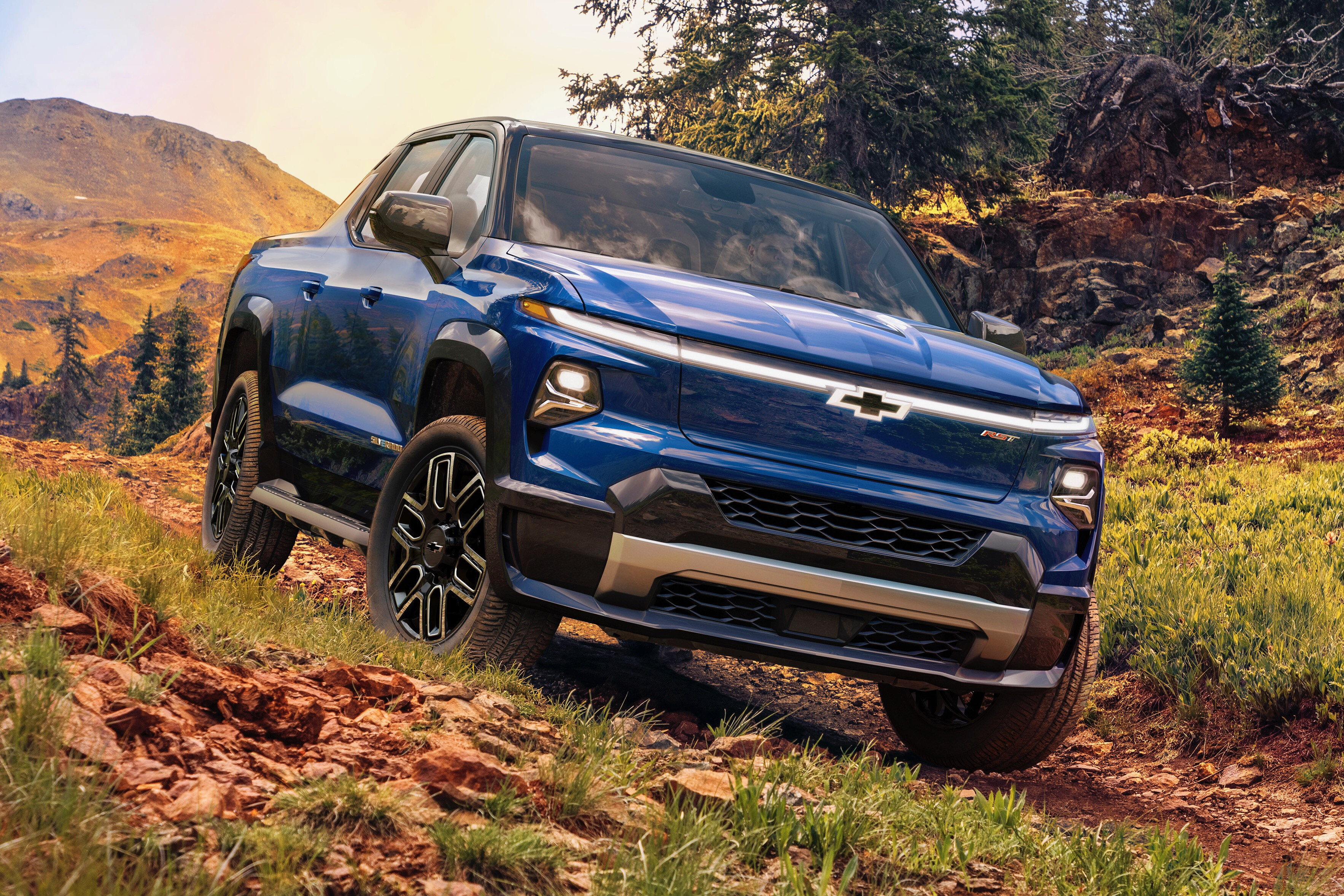
The Chevrolet Silverado EV is a full-size all-electric ute built on GM’s Ultium platform, offering dual-motor all-wheel drive with up to 541kW and 1051Nm in performance trims.
Depending on the battery and variant, it can deliver up to around 780km of range and supports heavy-duty towing of roughly 4500 kg, making it suitable for work or lifestyle use. Global trims include the fleet-focused Work Truck, the retail-oriented RST/Max Range, and the off-road Trail Boss, with features such as 350kW DC fast charging, adaptive air suspension, four-wheel steering, configurable tailgate and Midgate, and exportable onboard power.
The Silverado EV is not officially sold through Australian dealers, but right-hand-drive conversions by specialist importers like Autogroup International make it accessible for local buyers seeking a full-size American electric ute experience.
Rivian R1T: TBC
The Rivian R1T is an all-electric mid‑size ute available overseas in dual‑motor and quad‑motor all-wheel-drive configurations.
The quad-motor setup provides advanced torque vectoring, while adjustable air suspension raises clearance to 381 mm. Acceleration is brisk, with 0-97 km/h in the low-three-second range depending on battery and motor choice. Battery options span 105kWh, 135kWh and 149kWh, delivering 370-645 km of range under WLTP/EPA testing. The cabin features a 12.3‑inch digital cluster, 15.6‑inch touchscreen, multiple drive modes, and utility options such as the Gear Tunnel.
In Australia, the R1T is not officially sold and no RHD consumer version exists. A small number of left-hand-drive units have been imported for mining and industrial use by WA-based MEVCO, and a test mule was spotted on Melbourne roads in late 2025. These vehicles are typically limited to private sites and aren’t road-legal for general public use.
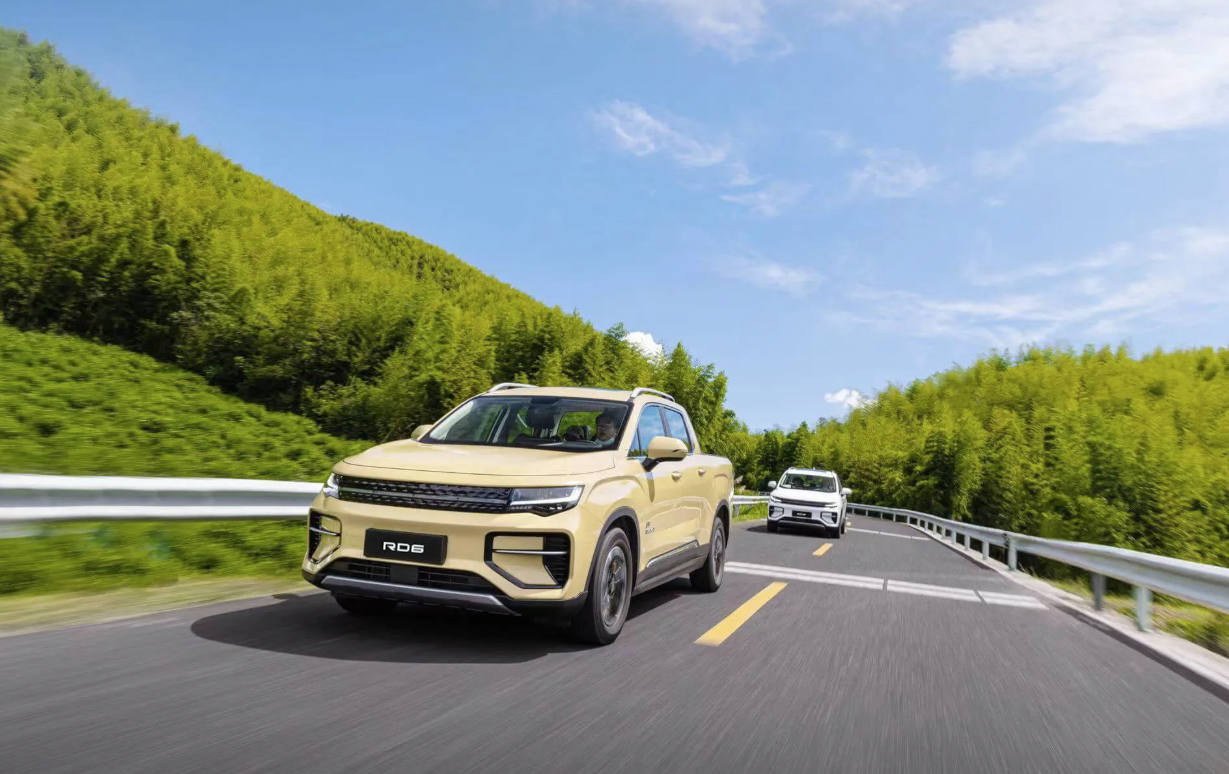
Riddara RD6: TBC
The Riddara RD6, an all-electric dual-cab ute from Geely’s Radar brand, is poised to enter the Australian market.
It offers RWD and AWD variants, with power ranging from 200kW/384Nm (RWD) to 315kW/594Nm (AWD), and 0 to 100 km/h times of around 7.3 and 4.5 seconds respectively. Battery options deliver 385-500 km of range (CLTC), and AWD models can tow up to 3000 kg braked.
Inside, the RD6 features a 14.6‑inch touchscreen, digital instrument cluster, dual‑zone climate, and utility-oriented comfort for work or off‑road use. Right‑hand-drive production has been confirmed, and the RD6 has launched in Thailand, making an Australian release possible in 2026, though pricing and full specifications are yet to be announced.
Isuzu D-MAX EV: TBC
The Isuzu D‑MAX EV is a fully electric version of the popular midsize ute, with right-hand-drive units expected in Australia in 2026.
While Isuzu Ute Australia has not confirmed local availability or pricing, the EV features a dual-motor full-time 4×4 system producing 140kW and 325Nm, paired with a 66.9kWh battery delivering about 263km WLTP range. Payload is listed at 1010kg and braked towing capacity 3500kg, matching the diesel D‑MAX.
In 2025, Isuzu UK announced pricing will start from £59,995. That works out to around $117,000 AUD before on-road costs. First deliveries in the UK are expected in March 2026, following an official launch in February. However, there’s been no confirmation yet for an Australian release.
JAC T9 EV: TBC
The JAC T9 EV is a fully electric dual‑cab 4×4 ute showcased in Australia, though local sales and pricing have not yet been confirmed.
JAC has also begun mining-industry trials in Western Australia to test performance and battery durability under harsh conditions. It pairs an 88 kWh LFP battery with a dual-motor AWD system producing 220 kW and 516 Nm, offering an estimated 330 km WLTP range. Practicality is retained with a 900 kg payload, a tub sized for a standard Australian pallet, and vehicle-to-load functionality for powering tools or campsite gear.
While timing for a full Australian rollout is unclear, the T9 EV remains one of the more realistic near-term electric 4×4 ute options for tradies, fleets, and off-road enthusiasts.
Ford F-150 Lightning EREV: 2027
The next-generation Ford F-150 Lightning Extended Range Electric Vehicle (EREV) is expected to arrive in Australia in 2027, as a right-hand-drive conversion model sourced from the US in left-hand drive and converted locally before being released to market, rather than being officially sold by Ford Australia.
The EREV moves away from a pure battery-electric setup, using electric motors to drive the wheels alongside a smaller battery and a petrol engine that acts only as a generator. The engine does not provide direct drive, instead extending range by replenishing the battery on the move. While full specifications are still to be confirmed, US figures suggest a combined driving range of more than 1125km, significantly up on the current Lightning’s 386km to 515km depending on variant.
Key capabilities are expected to continue, including dual-motor all-wheel drive, strong towing capacity, DC fast charging, and vehicle-to-load functionality that allows the ute to power tools and equipment.
BYD Shark 2.0: Late 2026
The BYD Shark 6 is set to gain a more powerful 2.0-litre plug-in hybrid variant, forming an upgraded “Shark 2.0” line-up for Australia.
The revised model builds on the existing Shark 6 formula, retaining the dual-motor PHEV system but replacing the 1.5-litre turbo petrol engine with a larger 2.0-litre unit for improved load and towing performance. Combined outputs are expected to rise to around 345kW and 700Nm, alongside a significant boost in braked towing capacity to 3,500kg, addressing one of the current model’s key limitations.
The upgrade also focuses on maintaining performance under heavy load, with revised motor tuning and a stronger hybrid system designed to improve real-world towing and long-distance capability when the battery is depleted. While pricing and final Australian timing are yet to be locked in, the Shark 2.0 is expected to join the existing range as a more capable flagship variant, further strengthening BYD’s growing presence in the dual-cab ute segment.
Ford Ranger Super Duty Pick-Up and XLT: Mid-2026
Ford is set to expand its heavy-duty ute offering with the arrival of the Ranger Super Duty XLT and Pick-Up variants in mid-2026.
Built around a reinforced chassis and upgraded running gear, the Super Duty is powered by a 3.0-litre turbo-diesel V6 producing 154kW and 600Nm, paired with full-time 4WD and engineered for extreme towing and payload demands.
The headline change is the introduction of the factory Pick-Up body style alongside cab-chassis options, giving buyers a ready-to-go tray setup straight from the factory. The XLT grade adds a more touring-focused specification, including 18-inch alloy wheels, leather-accented heated and ventilated front seats, carpet flooring and all-weather mats, positioning it as a more comfortable long-distance and recreational option without sacrificing core capability.
Across the range, the Ranger Super Duty is engineered for serious workloads, with 4500kg braked towing capacity, 4500kg GVM and 8000kg GCM, supported by heavy-duty axles, brakes and reinforced underbody protection. The Pick-Up variant is expected to broaden its appeal beyond fleet and trade users into the touring and towing market when it lands locally.
2026 KGM Musso: Mid 2026
The 2026 KGM Musso range is set to arrive in Australia as a refreshed version of the brand’s long-running dual-cab ute. The line-up is expected to include multiple grades, with updated styling, improved interior tech and a more refined equipment spread across entry, mid and flagship variants.
Power continues to come from a 2.2-litre turbo-diesel engine producing around 133kW and up to 441Nm, paired with a six-speed automatic transmission and part-time 4×4 system with low-range gearing. Capability remains a key focus, with a 3500kg braked towing capacity, solid payload figures and a ladder-frame chassis designed for trade and touring use.
Equipment upgrades include a larger digital display setup, improved infotainment with smartphone integration, and expanded driver assistance features, while higher grades add more comfort-focused features to lift long-distance usability.
Mahindra Pik-Up: Late 2026
The next-generation Mahindra Pik-Up is expected to arrive in Australia around 2026, marking a full redesign of the brand’s long-running dual-cab ute.
Codenamed Z121, the new model shifts to an all-new ladder-frame platform with a stronger focus on safety compliance, refinement and broader appeal, addressing the shortcomings that saw the previous generation phased out locally.
Under the bonnet, the Pik-Up is expected to continue with a 2.2-litre turbo-diesel engine, tuned for improved performance and torque delivery, with reports also pointing to a hybrid variant joining the range later in the cycle. Capability remains central to the formula, with a traditional part-time 4×4 system, low-range gearing and a payload and towing focus aimed at both trade and recreational users, while a major upgrade in safety tech is expected to bring it in line with modern Australian standards.
For more than 40 years, I’ve been pumping up tyres the slow way.
Back in the day – as a teenager – I relied on my old man’s trusty foot pump. Thirty to forty minutes of leg work just to bring pressures back up after a weekend of low-psi fun. Hard yakka, but it did the job.
Then came the game changer: my first single-head 12V compressor. At the time, I felt like king of the track, kicking back while it did the hard work for me. Since then, I’ve owned a few different models – all single-cylinder – and never really felt the urge to upgrade.
Sure, I’ve tested plenty of twin-head units over the years, ranging from bargain-bin specials to top-shelf monsters. But none ever tempted me enough to make the switch.
Hoses and attachments
Then came the era of inflation kits – head units, multi-hose systems and all sorts of fancy gizmos claiming to make tyre inflation quicker and easier.
Sure, some did streamline the job, but having a compressor, a control unit and four separate hoses to unwind, store and inevitably untangle just didn’t make sense to me. Add in all the extra gear you need to carry, and suddenly a basic job turns into a storage hog – all for marginal time savings.
Light bulb moment
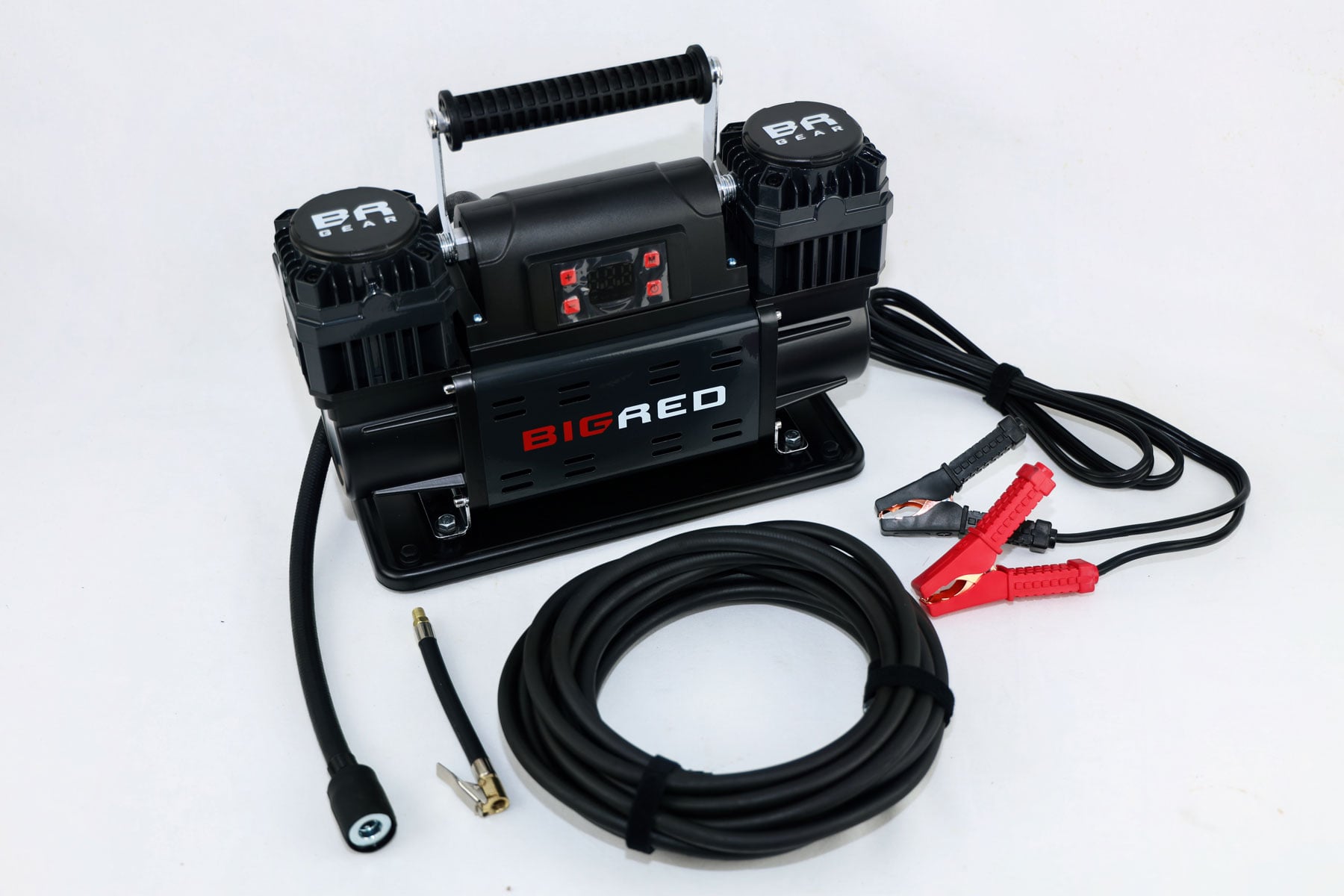
While trawling through the usual sea of aftermarket accessories, the Big Red Gear twin-head air compressor caught my eye. For the price, it looked impressive – especially with features like auto cut-off when a preset digital pressure is reached. Add the optional Quad-Flate kit, and you get rapid deflation capability too – a big plus in my books.
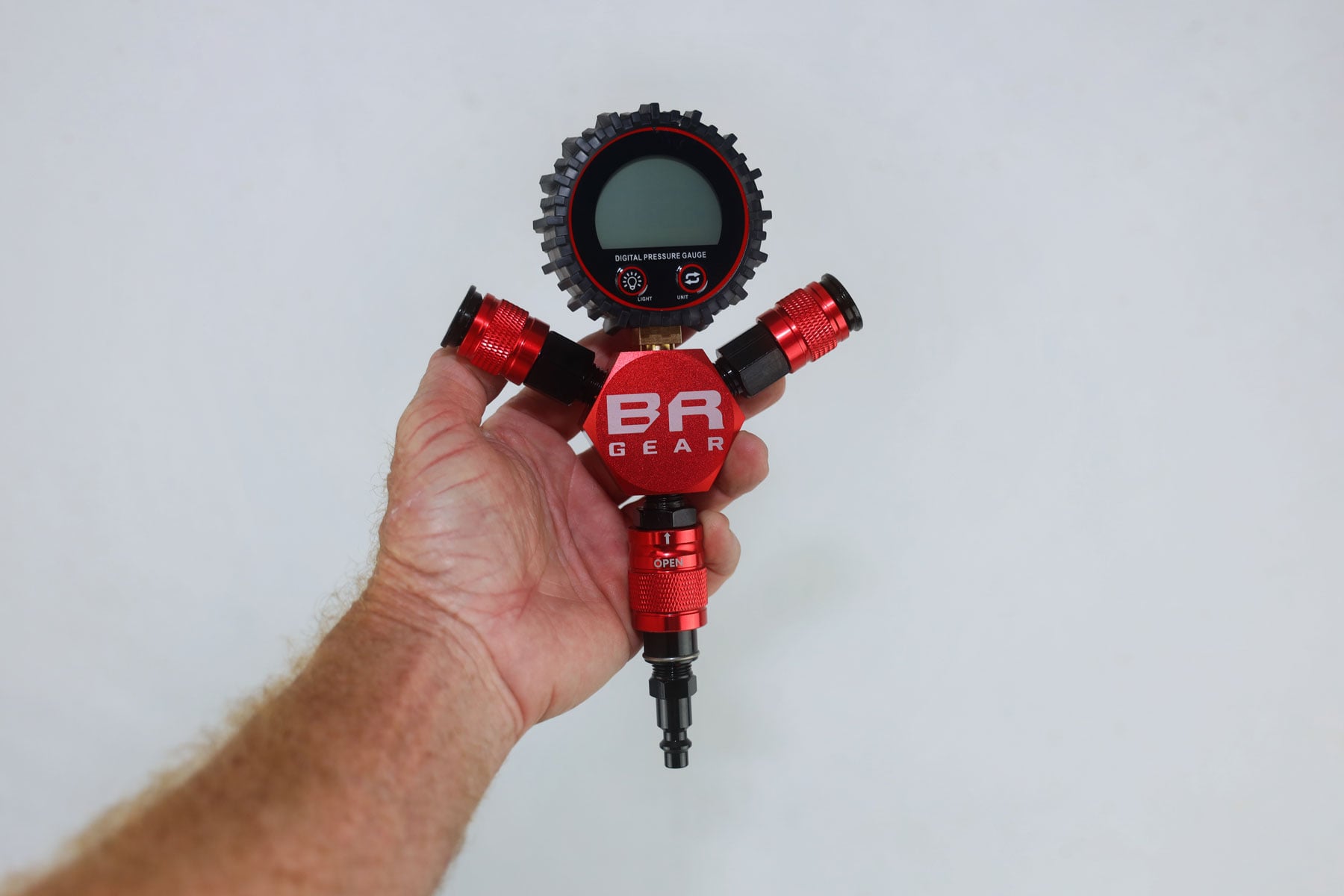
The real clincher? Unlike most four-tyre inflation setups that use four separate hoses, this one runs all four tyres with just two. Now that’s a system I actually wanted to try.
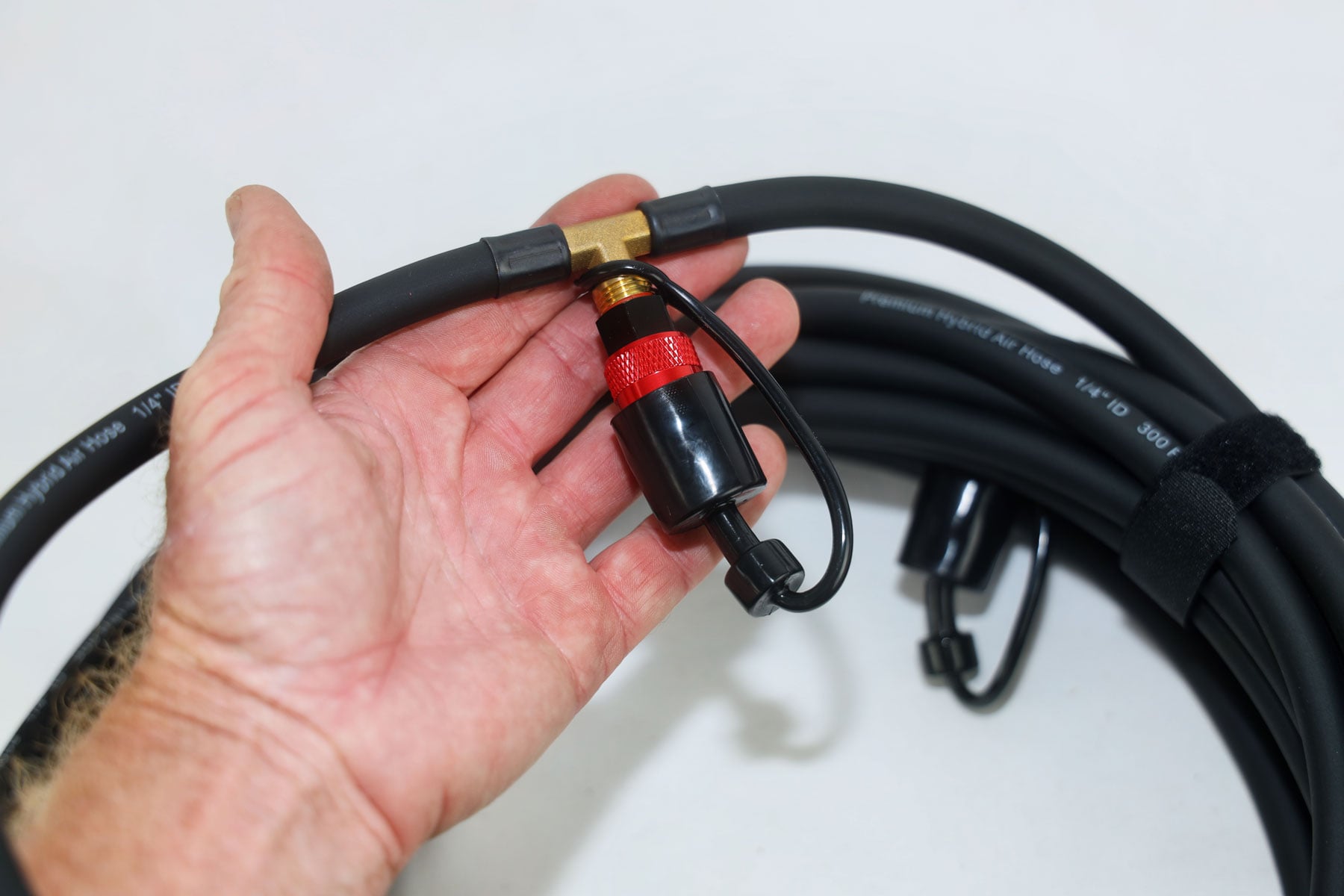
The trick lies in the hose design. Each of the two main lines has a T-junction part way along, allowing for a direct connection to the third and fourth tyres, which accept or release air as needed.
That setup impressed me – fewer hoses to untangle, less gear to stash. So I pulled the trigger and now run both the Big Red Gear 12V Twin Head compressor and the optional Quad-Flate kit.
All in the name of long-term testing. I’ll start by timing inflation and deflation across a few scenarios – one tyre, two tyres, and all four – to see how the system handles real-world use.
After that, the kit’s going into the 4×4-converted HiAce for an eight-week run to North Queensland, finishing with a celebratory photo at the tip of Cape York. Safe to say it’ll get a solid workout – and I’ll report back with the verdict, good, bad or otherwise.
Slower or not?
Here’s the theory I was told: pumping up two tyres at once with a single compressor doesn’t take twice as long as inflating one – and doing all four won’t take four times longer. In fact, it’s not even double the time of two tyres.
You see, the biggest bottleneck in any inflation setup is the tyre valve itself. Flow rates vary depending on the pressure in the tyre, so it’s tricky to pin down exact figures – but the restriction is always there. The fastest way to pump up a tyre is with the valve core removed, feeding air directly into the stem. But let’s be honest – that’s not something most people want to mess with. I know I don’t.
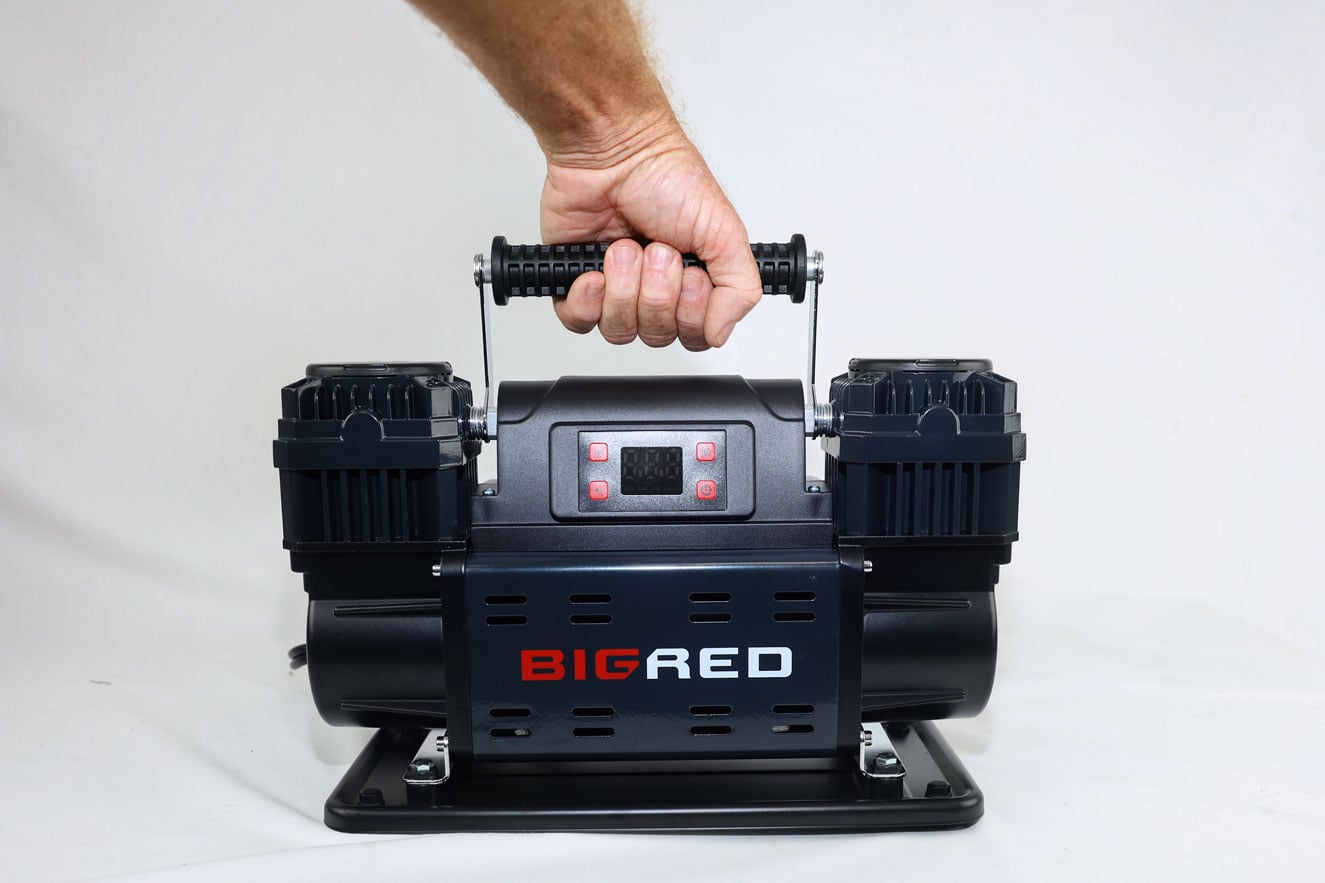
The Big Red Gear compressor is rated to a maximum flow of 300L/min and 150psi. In reality, though, the actual flow rate depends on the pressure in the tyres – just like the airflow restriction at the valve, it’ll vary as you go.
Since the compressor pushes out more air than the tyre valve can take in, there’s naturally a bottleneck – and that restriction slows airflow through the system. One side effect of that is heat. The compressor, hoses and head unit all warm up under pressure, and the more resistance in the system, the hotter it gets. And excess heat? That’s never a good thing for long-term reliability.
Now split that airflow in two and inflate two tyres at once. Same air output, but with less restriction, less wasted pressure, and less heat – sounds like a better system already, right?
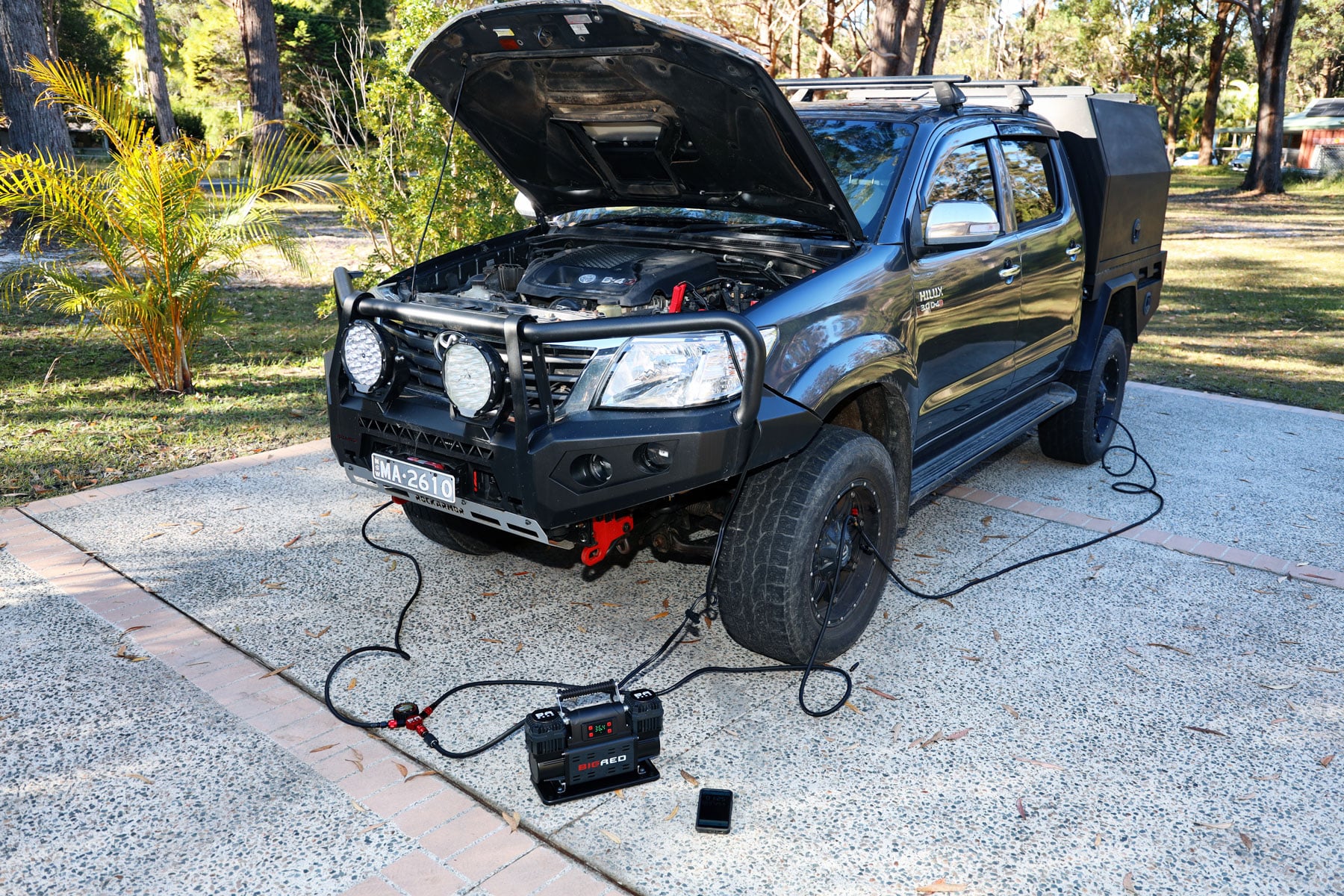
Double it again and run all four tyres at once. With more outlets for the air to escape, you’re getting closer to the compressor’s maximum flow rate. That means lower system resistance, reduced heat buildup and, in theory, faster inflation times across the board.
Testing time – Inflation
That’s all the theory – now for the real-world results. Check out the table for the actual figures, inflating from a typical beach pressure of 20psi back up to a bitumen-ready 40psi.
I had grand plans to measure compressor temps, along with the chuck and Quad-Flate head unit before and after inflation… but like many good intentions, that testing went straight out the window.
Why didn’t I bother with precise temperature readings? Simple – it was easy enough to measure the starting temps before use, but once the compressor, chuck and Quad-Flate head unit warmed up, they stayed hot for long enough to throw off any consistent comparisons.
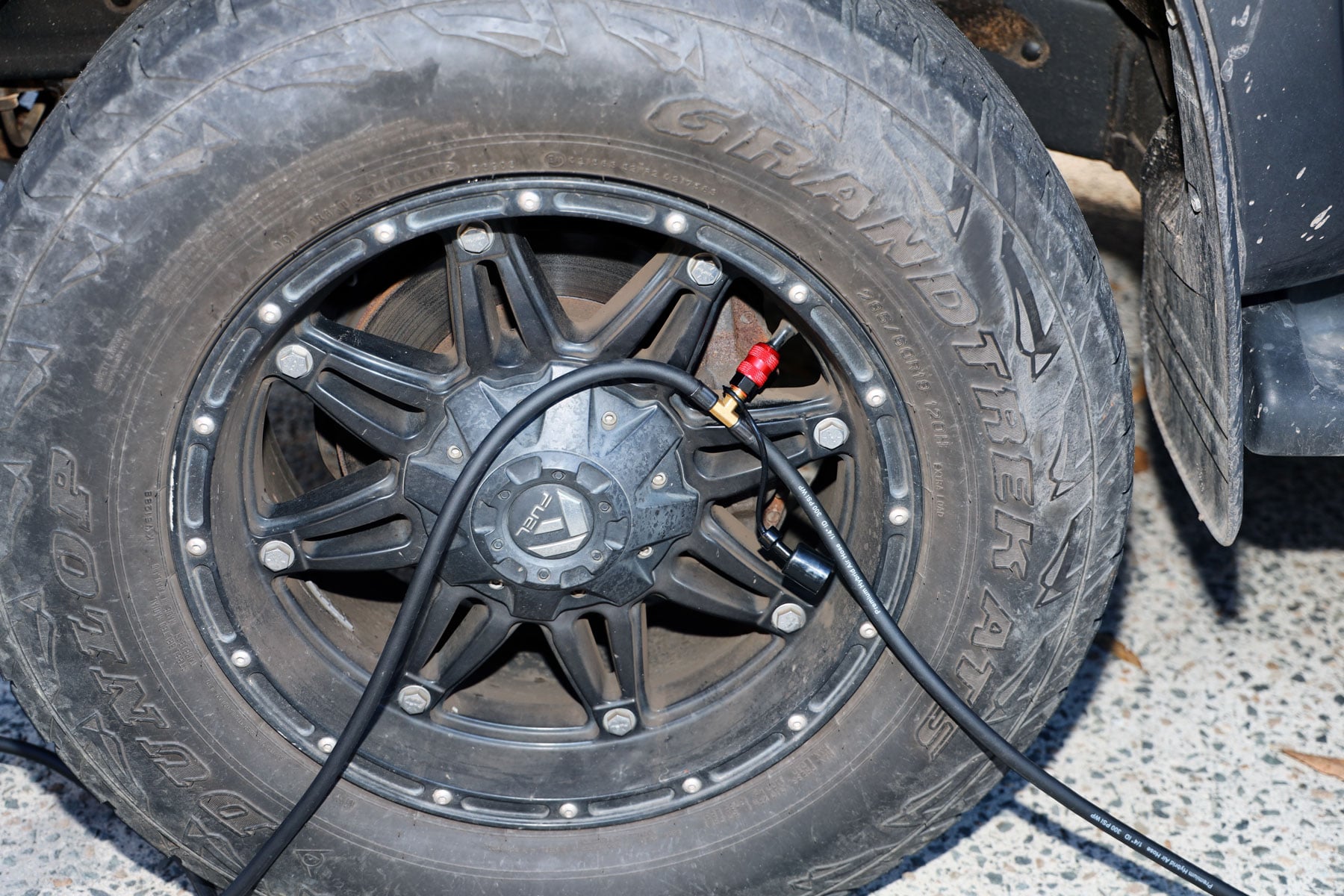
That said, during testing, the compressor got warm after repeated use but never scalding – it stayed comfortable to handle. The only component that got too hot to touch was the four-way head unit, and that was after multiple back-to-back runs. In real-world use, you’re only inflating a set of tyres once – not running repeated test cycles.
The included carry pouch doubled as a heat shield and made hose disconnection easy even when things were warm. At no point did the thermal cut-out or over-current protection kick in. Given the compressor’s speed and short run times, I’d be confident inflating multiple vehicles without any trackside delays.
As the table shows, doubling the number of tyres didn’t double the time – enough proof for me that this setup saves valuable minutes trackside.
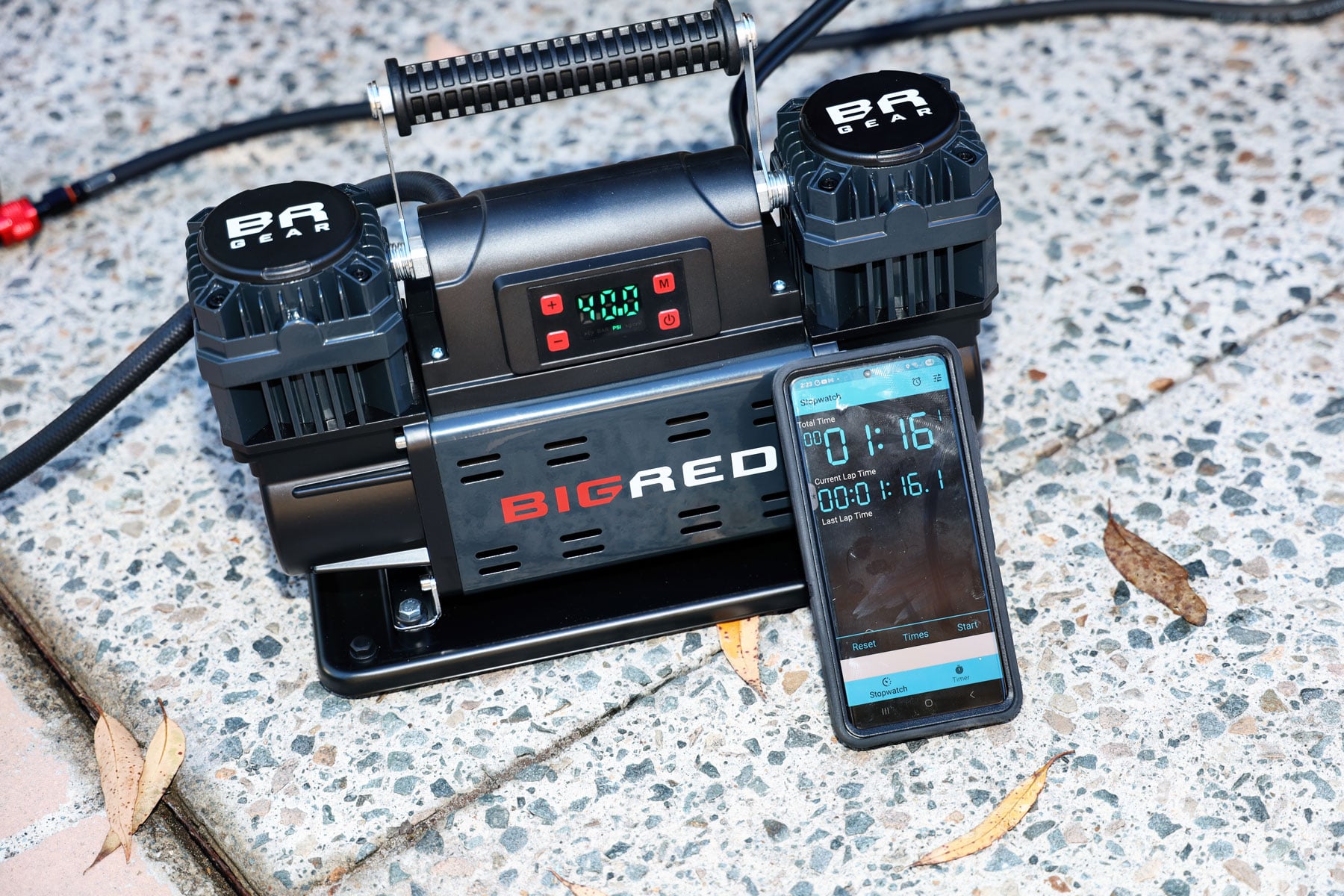
To put it plainly: inflating one tyre from 20 to 40psi took 1 minute and 16 seconds. Multiply that by four and you’d expect a total of 5 minutes and 4 seconds. But with the Quad-Flate system, all four tyres were done in just 4 minutes and 3 seconds – saving nearly a full minute.
Not bad, eh?
The Big Red Gear compressor is quick on its own, but pair it with the twin-hose Quad-Flate system and it’s even quicker.
Inflation Times: 20psi to 40psi
| Number of Tyres | Time Taken |
|---|---|
| One tyre | 1m 16s |
| Two tyres | 2m 14s |
| Four tyres | 4m 03s |
Tested on 285/60R18 tyres (approx. 31.5-inch overall diameter).
Testing time – Deflation
Using the Quad-Flate hose kit, I repeated the same test in reverse – dropping pressures from 40psi down to 15psi with one, two and four tyres deflating at once.
One handy feature of the Quad-Flate system is its ability to handle uneven tyre pressures. I often run different front and rear pressures due to load balance – typically heavier at the rear. For example, on sand I might go down to 20psi at the rear and 15psi up front. The system can manage that easily, letting you monitor and isolate pressures as needed.
The trick with this setup is to start by lowering all four tyres – with all four lines connected – to the higher of your target pressures. In the earlier example, that’s 20psi. The system will deflate until all four tyres hit 20psi, then stop.
From there, just disconnect the two rear lines, leaving the fronts hooked up, and drop them to 15psi. Job done.
It works the same way in reverse when inflating. Set your lower target pressure first – say 35psi for the front – and let the system run all four. When it cuts out, remove the front lines, bump the gauge to 40psi, and inflate the rears. Simple and efficient.
Another way
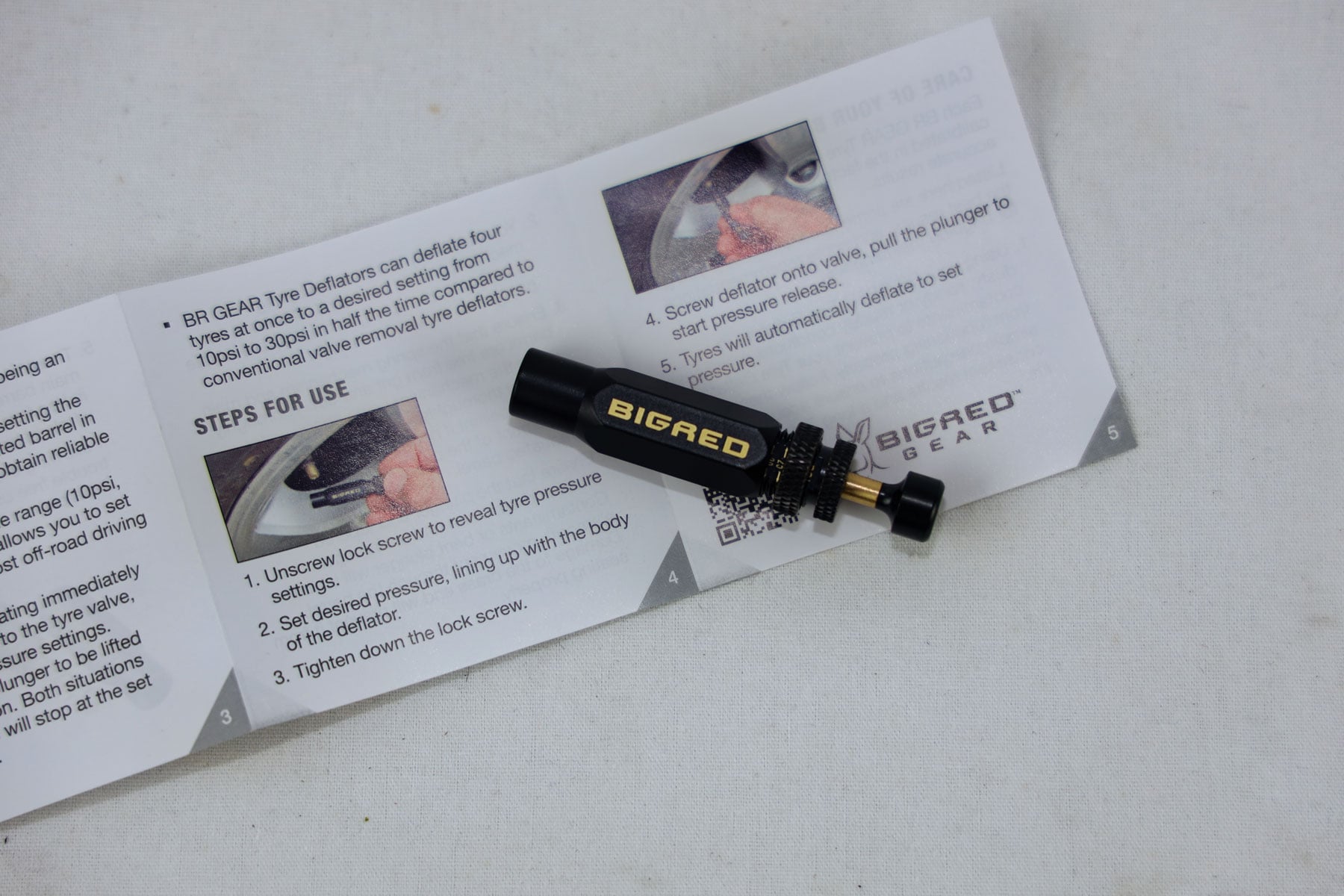
If you’re not keen on using the Quad-Flate kit for deflation, there’s always the tried-and-true method – screw-on automatic deflators. For comparison, I also included a set of Big Red Gear’s four-piece deflators in the test.
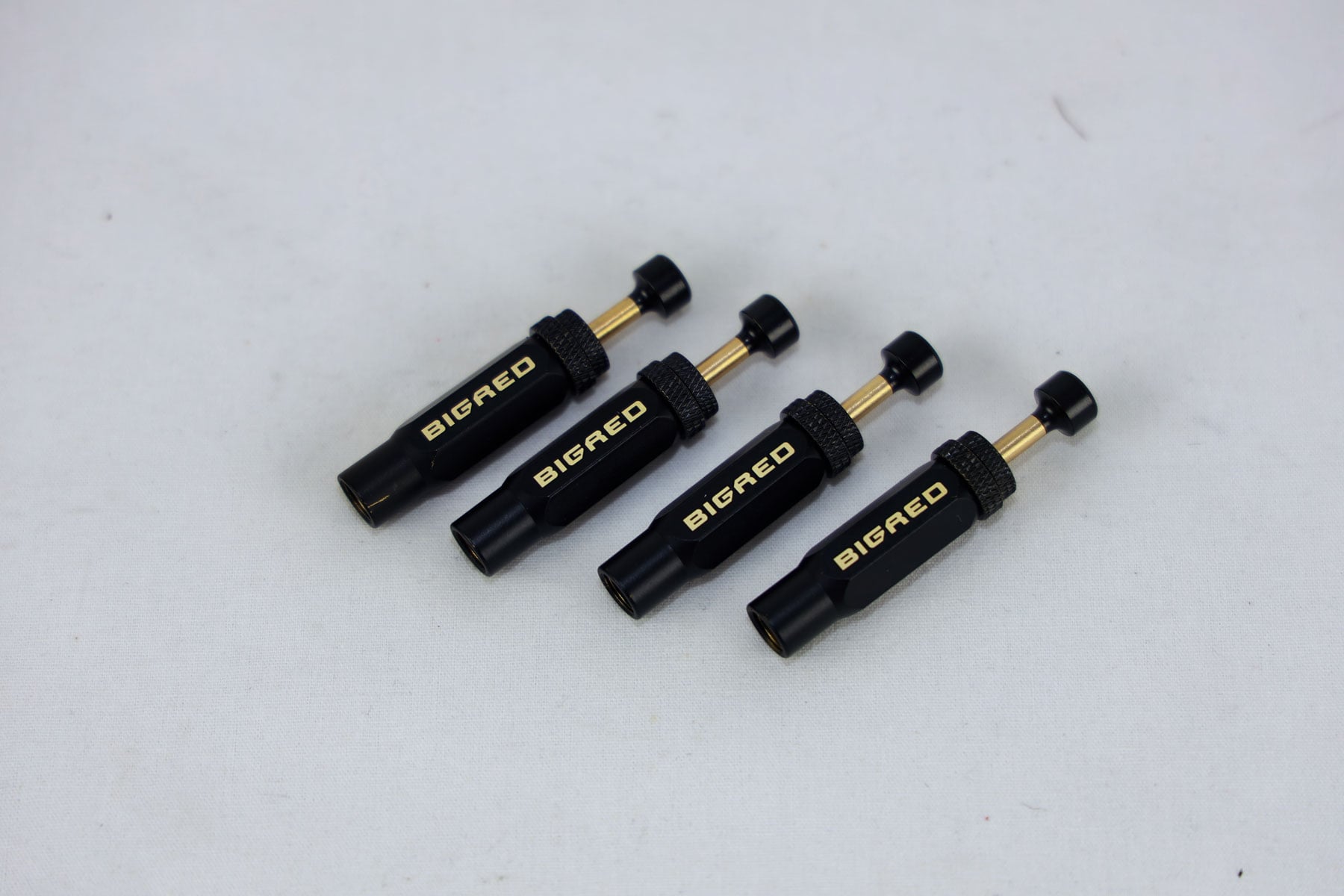
The table shows deflation times from 40psi down to 20psi. Of course, your own start and finish pressures may vary, and factors like tyre size and vehicle weight will also affect results. But the differences between deflating one, two or four tyres at once clearly highlight just how much time you can save – and which method is most efficient.
Check out the table for the results – just note that I haven’t factored in the time it takes to walk around and screw on each of the four auto deflators. I timed a single tyre deflation and used that figure for the two- and four-tyre results with the autos, just for consistency.
With the Quad-Flate, I tested one, two, and four tyres as the system is designed to do. And here’s the kicker – it’s much faster than the auto deflators.
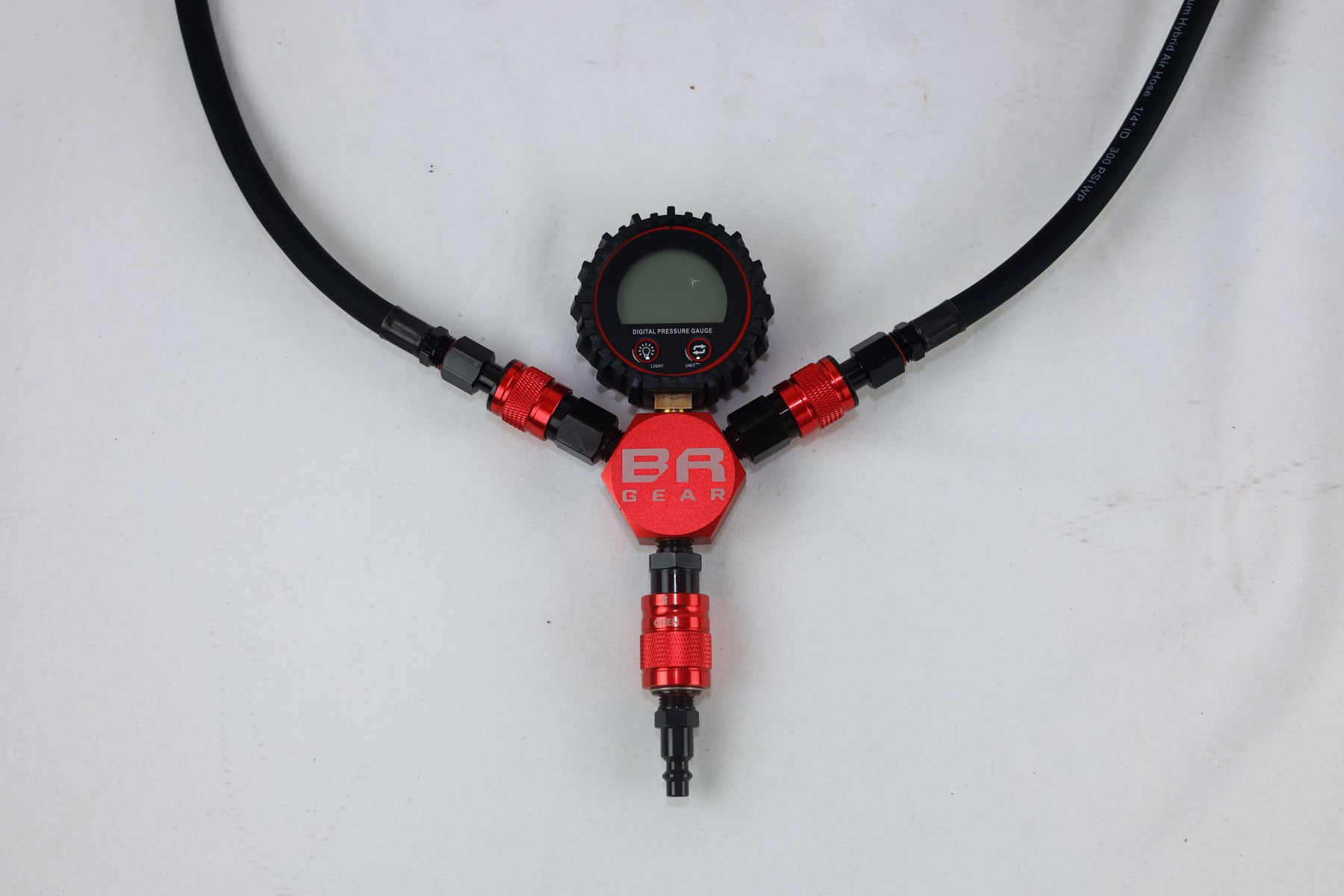
One idea for Big Red Gear: a short 10cm hose would make the head unit easier to use as a stand-alone deflator on single tyres. A small tweak, but it’d be a handy one. Let’s see if the mob at Big Red Gear are listening.
Deflation Times: 40psi to 20psi
| Number of Tyres | Quad-Flate Kit | Auto Deflators |
|---|---|---|
| One tyre | 1m 29s | 3m 10s |
| Two tyres | 1m 37s | 3m 10s* |
| Four tyres | 1m 54s | 3m 10s* |
| *Auto deflator time based on a single-tyre measurement and applied to all tyre counts for comparison. | ||
Tested on 285/60R18 tyres (approx. 31.5-inch overall diameter).
While this testing backs up the theory on faster inflation and deflation times, it’s no long-term durability test. Our trip to the Tip and back will clock up around 10,000km – with at least a quarter of that off-road.
I’ve got no idea how many times I’ll be adjusting tyre pressures along the way, or which method I’ll end up favouring. But rest assured, we’ll be putting the Big Red Gear inflation system through its paces – and I’ll report back not just from this big lap north, but from plenty of shorter local jaunts too.
Let’s see how it holds up in the long run.
All up, both the compressor and deflation kit performed flawlessly. I was especially impressed by the quality of the hoses – they roll and unroll easily without kinking, don’t get overly hot, and have more than enough length to reach all four wheels.
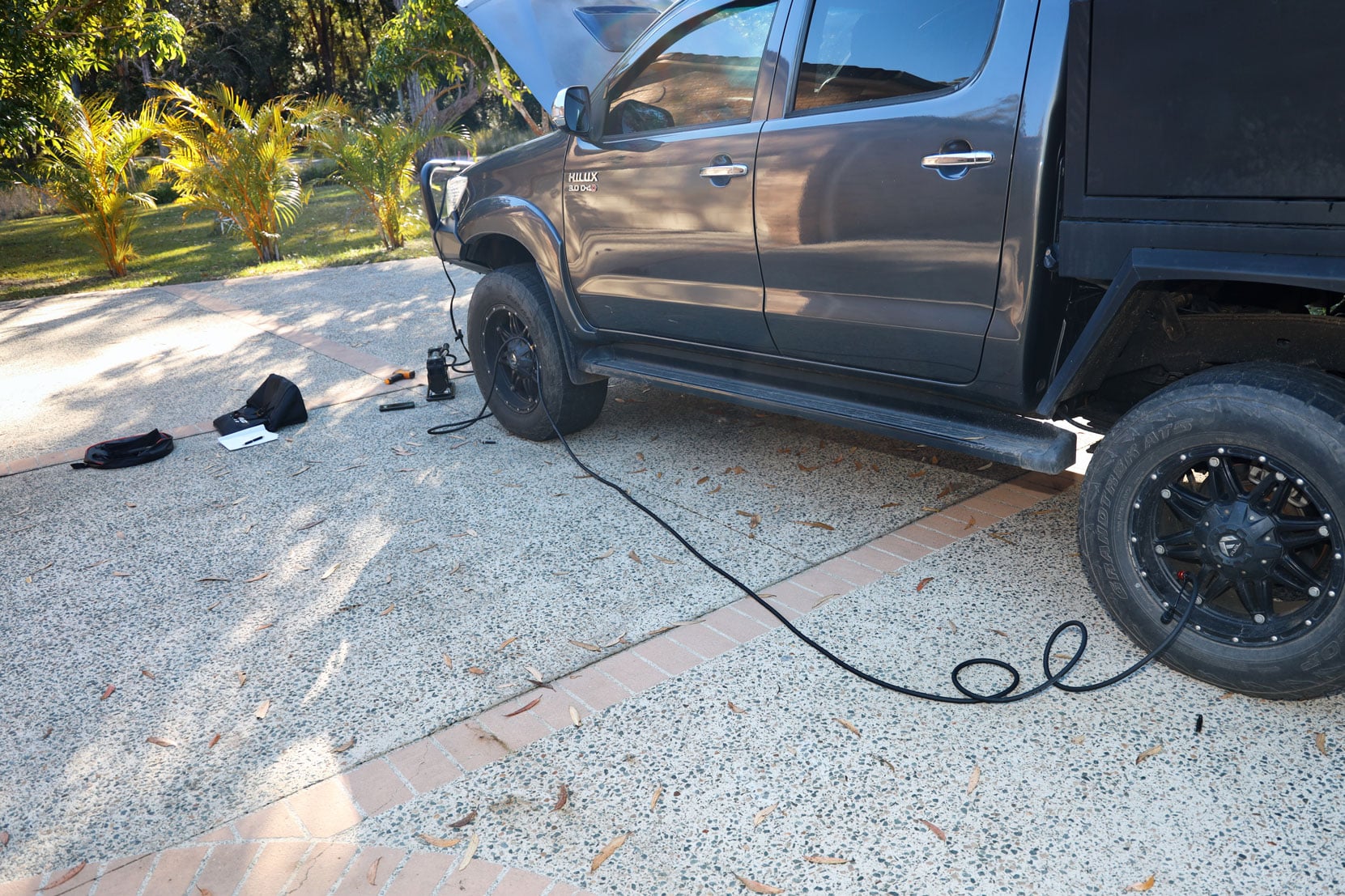
The compressor itself is a solid bit of gear – it looks and feels well built, ran quieter than many units I’ve tested, and outperformed my expectations for both speed and ease of use.
While the unit features an automatic pressure cut-off, it can also be run in manual mode. There’s a built-in bleeder valve too, which makes it easy to fine-tune pressures or drop a few psi at a time. It also helps depressurise the system, so disconnecting the hoses is quick and fuss-free.
Overall, I rate the Big Red Gear setup as one of the best compressors I’ve used. The performance, build quality and thoughtful features set it apart. There’s no onboard air tank – but with inflation this quick, it simply doesn’t need one.
- RRP: $279 (twin-head portable air compressor); $399 (twin-head portable air compressor with Quad-flat kit); $49 (4-piece automatic tyre deflator kit)
- WEBSITE: https://bigredgear.com.au/
- WE SAY: A fast, well-built and cleverly designed tyre inflation and deflation kit that is one of the best we’ve tested.
Twin Head Air Compressor – Specifications
- Power: 1080W
- Input voltage: 12.0-13.5V DC
- Max current: 90A
- Max pressure: 150psi (preset) and 125psi (manual) – auto cut-off
- Max air flow: 300L/m; 10.6cfm
- Overcurrent protection: Yes (over 120A)
- Over temperature protection: Yes (over 120°C)
- Pressure unit switch: Yes
- Cylinder size: 2mm x 60mm
- Air delivery hose length: 7.75m
- 12V power lead length: 1.8m
- Digital pressure gauge: Real-time in-tyre pressure ±2psi
Quad-Flate Digital Hose Kit – Specifications
- Hose quantity: 2 x hoses (4 tyres)
- Length: 2 x 7m
- Hose colour: Black
- Hose material: Premium Anti-kink Hybrid Polymer
- Suits vehicle wheelbase: 4500mm
- Tyre fitment chucks: 4
- Chuck colour: Red
- Tyre gauge (deflator/inflator): Digital
- Units of measure: psi, bar, kPa, kg/cm2
- Max pressure rating: 200psi
- Batteries: 2 x AAA (not included)
Tweaked and tuned Triton Raider has arrived as the top-of-the-range model in Mitsubishi’s Triton ute range.
Not to be confused with the Ford Raider from the early 1990s, the Mitsubishi Triton Raider gets a range of upgrades in both styling and suspension.
Mechanically, the Triton Raider gets a new suspension package developed with Premcar; the same company responsible for the excellent suspension calibration on the new Nissan Navara which itself, is a product shared with the Mitsubishi ute.
At the front end, Premcar fitted new shock absorbers that include rebound springs internal rebound springs to help control the suspension at full compression for better ride and handling in rough conditions.
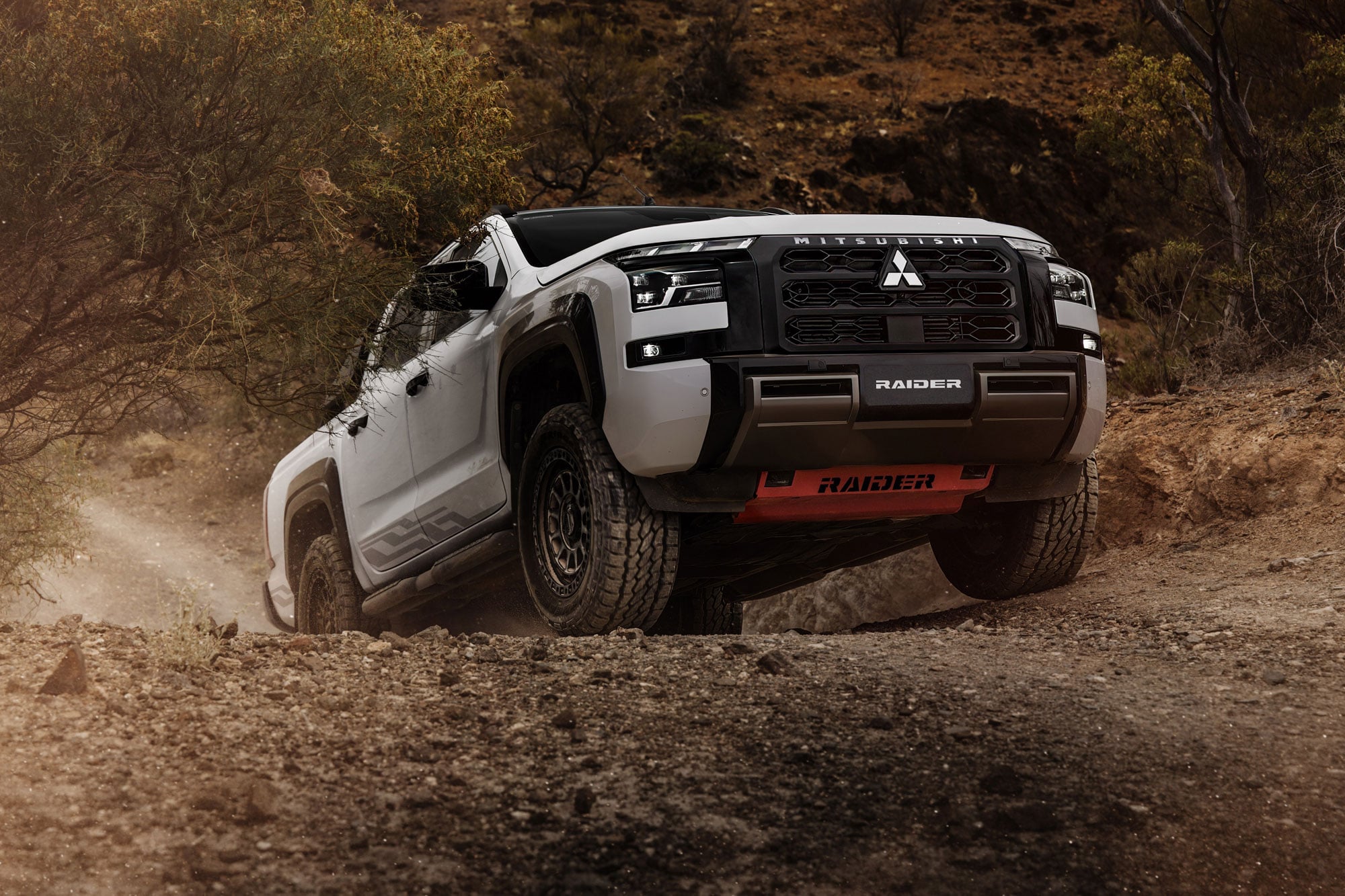
This internal rebound spring technology was recently debuted on the new Navara where we found it to do an excellent job of controlling the ride. The shocks in the Triton Raider are different to what is fitted to the Navara so we’ll have to wait until we drive the Raider before we can comment on them.
The upgraded suspension works in tune with Bridgestone AT002 all-terrain tyres, mounted to ROH ‘Assault alloy wheels. The tyres and suspension combine to give the Raider a 25mm ride height increase and also 20mm increased wheel track.
That’s the extent of the mechanical package but astatically the Raider gets model specific badging, a heavy-duty bash plate and specific sports bar and side protection bars with red highlights.
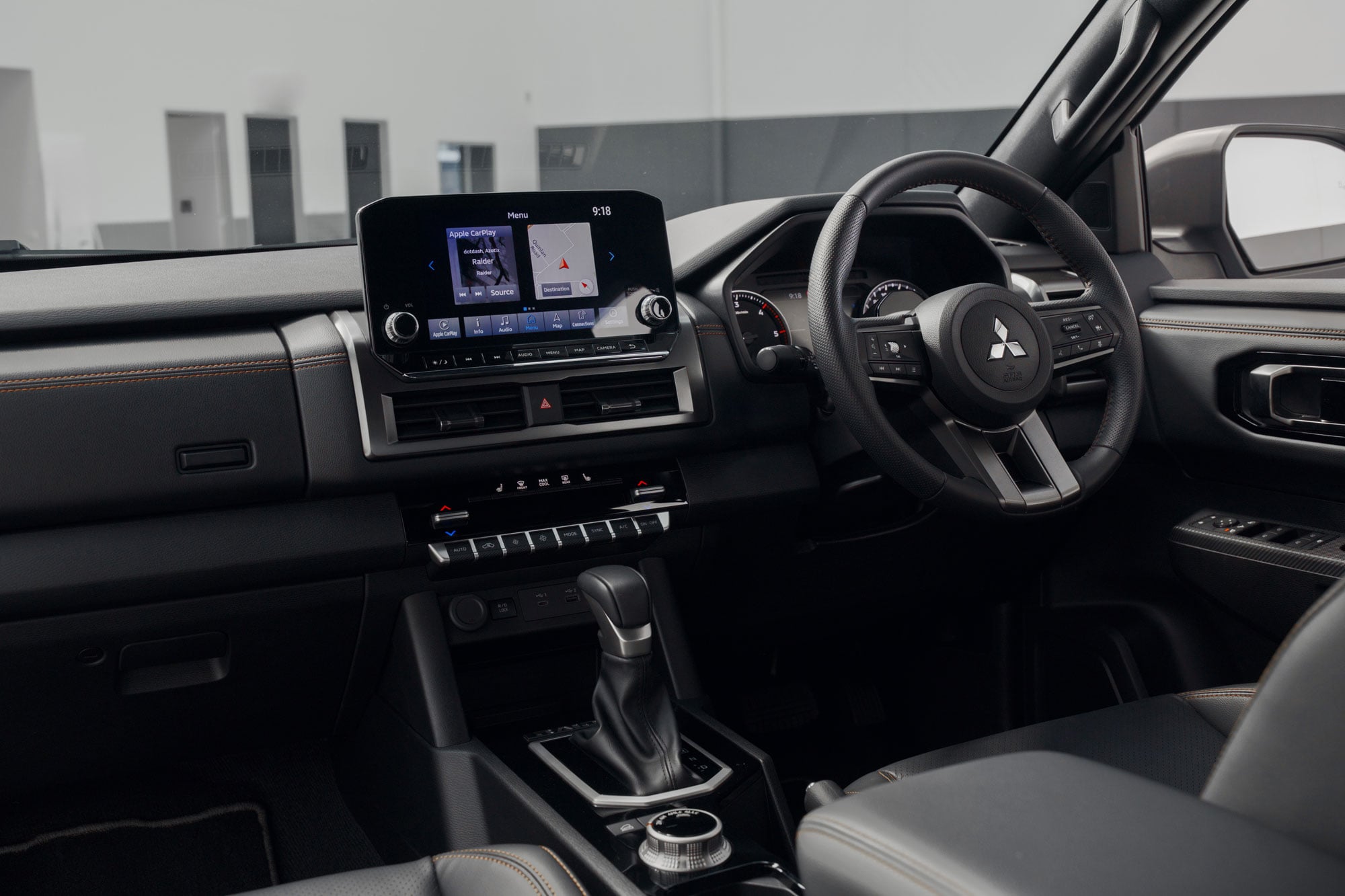
Based on the previously top-of-the range Triton GSR ($64,590+ ORC), the Raider is already well equipped. The engine remains the 2.4-liter twin turbo diesel that puts out that puts out a claimed 470Nm and 150kW, backed by a six-speed automatic transmission and Mitsubishi’s renowned Super Select dual range 4×4 system.
The Triton Raider will be in dealers from May, 2026 with the price yet to be disclosed.
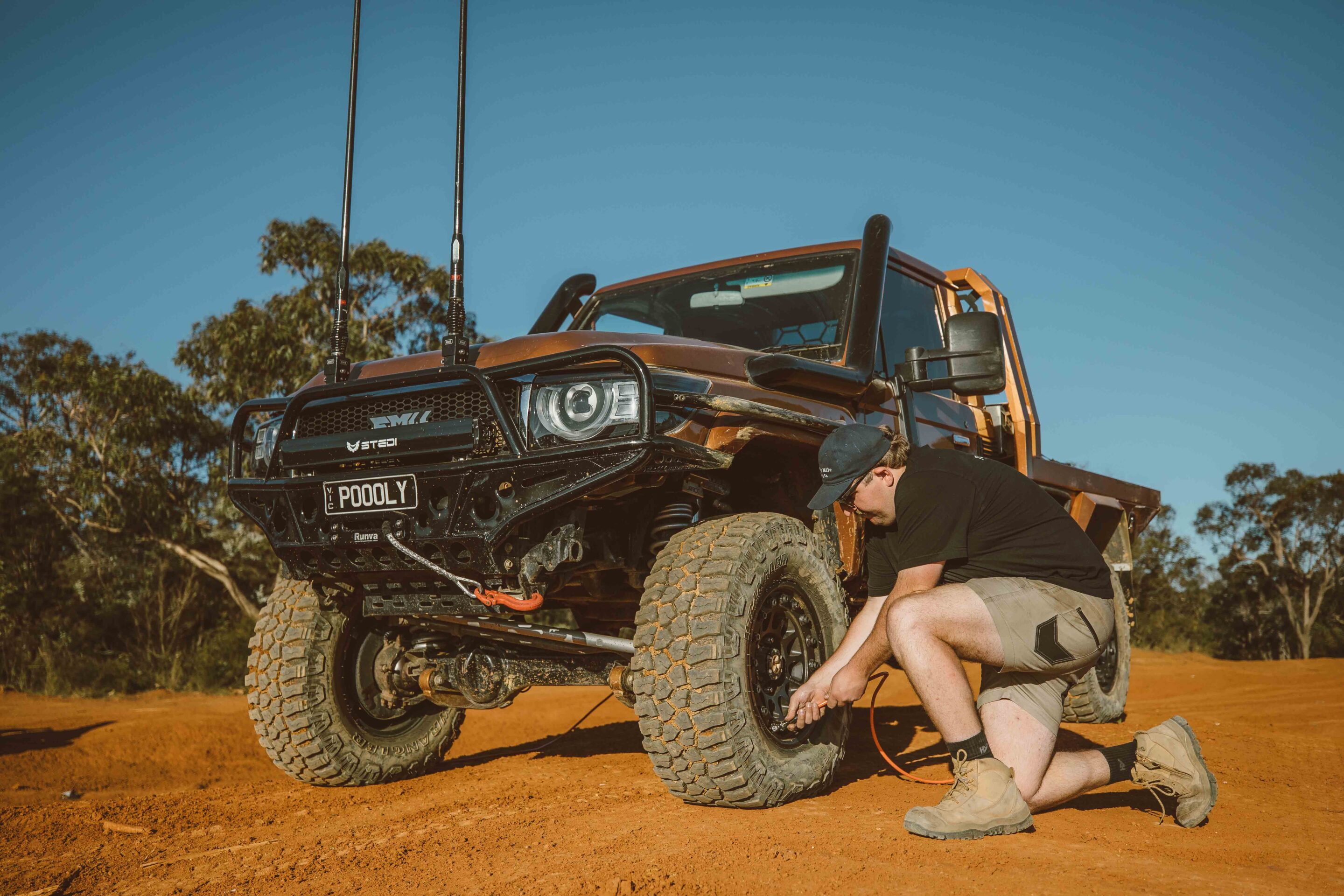
Uncle Pooly’s golden Toyota 79 Series LandCruiser has become one of the most recognisable builds on the Australian 4WD scene.
Designed for serious touring and tested across some of the country’s toughest terrain, the ute reflects a simple philosophy: build it tough, use it properly and rely on gear that performs when conditions get rough. At the centre of that off-road touring setup is Tuff Terrain gear, which Pooly regularly runs and tests across Australia’s harshest environments.
With more than 314,000 TikTok followers, 100,000 YouTube subscribers and 186,000 Instagram followers, Pooly has built a reputation for showcasing gear in real-world conditions rather than staged environments. His audience follows along for the builds, recoveries and track testing that come with pushing a vehicle across remote tracks and demanding terrain.
One area Pooly never compromises on is 4WD recovery gear. In fact, the partnership between Tuff Terrain and Pooly resulted in that co-created limited edition recovery kit, Uncle Pooly’s Ultimate Recovery Kit by Tuff Terrain. Available through Outback Equipment, it’s a permanent fixture in the back of the 79 Series, ready when traction disappears.
Whether it’s deep sand, muddy climbs or technical tracks, having a complete recovery kit on hand can mean the difference between continuing the trip and waiting hours for help. “If you’re stuck in remote country, your recovery gear has to work first time,” Pooly says.
Tyre pressure management is another critical part of serious off-road touring. Pooly runs a Tuff Terrain Compressor paired with the brand’s Retractable Air Hose Reel, making it quick and easy to air down before tackling sand or rough tracks and air back up again when it’s time to hit the highway. The retractable setup keeps the hose neatly stored and ready to deploy, which is especially useful when you’re adjusting pressures multiple times throughout a trip.
The Cruiser itself is built to handle punishment, running reinforced suspension with a double-triangulated four-link setup, King shocks, heavy-duty bar work and sliders, Goodyear mud-terrain tyres and engine tuning designed to balance torque with reliability. Every element of the 79 Series build has been carefully planned to handle Australia’s demanding off-road conditions.
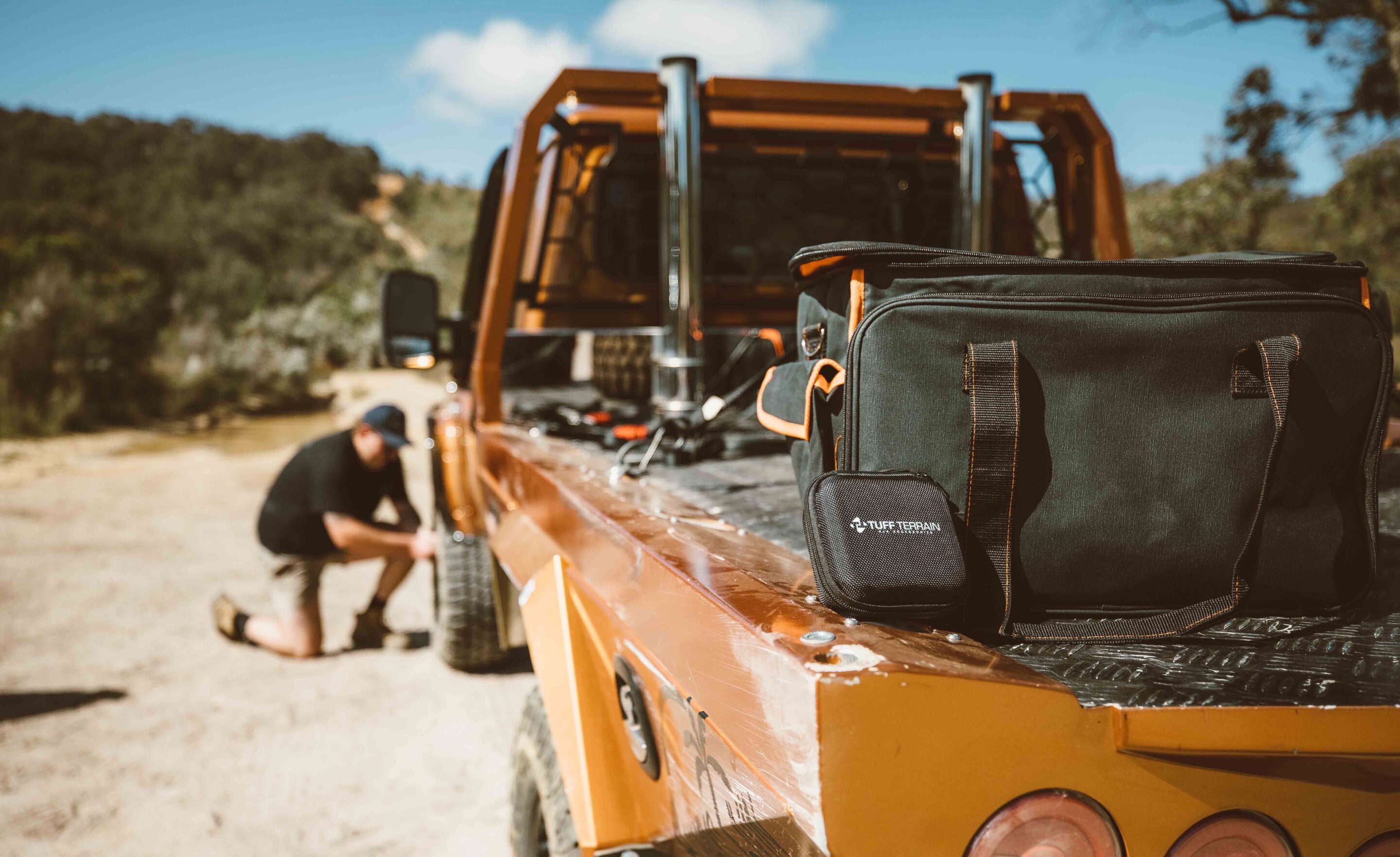
But it’s not just the exterior that takes a beating. After long days on dusty tracks and muddy recoveries, protecting the interior of the well-known golden ute is just as important. That’s where Tuff Terrain’s 3D Floor Mats and Universal Seat Covers come into play. The deep-moulded mats help trap sand, mud and debris before it spreads through the cabin, while the heavy-duty seat covers protect factory upholstery from wet gear, dirt and the daily wear that comes with serious off-road use.
For Pooly, gear isn’t about show – it’s about reliability in real conditions. His content regularly sees the 79 tackling iconic Australian destinations including Cape York and the Simpson Desert, where equipment is pushed well beyond everyday driving. By breaking down builds, modifications and recovery techniques in an approachable way, Pooly has built a following that values practical knowledge just as much as inspiration.
For Tuff Terrain owners, seeing the gear used in real conditions offers something more valuable than marketing claims – real proof that the right 4WD touring setup can handle Australia’s toughest tracks with confidence.
In the world of 4WD touring content, authenticity matters. For creators TJ & Mac, that means building vehicles the way everyday off-roaders do – carefully selecting upgrades that genuinely improve performance, reliability and capability on the tracks Australians actually drive.
Across their popular YouTube channel and social platforms, TJ & Mac document the process of building capable touring vehicles, sharing practical insights that resonate with both experienced off-roaders and newcomers to the scene. With more than 188,000 YouTube subscribers and 85,000 Instagram followers, their audience has grown around a simple idea: show what works, explain why it works, and test it in real conditions.
A consistent feature across their builds is the use of Tuff Terrain gear, particularly when it comes to recovery equipment and air management systems. Whether preparing vehicles for tough tracks or dealing with the inevitable challenges of off-road travel, TJ & Mac rely on Tuff Terrain recovery gear for every recovery scenario, putting it to work in mud, sand and rocky terrain.
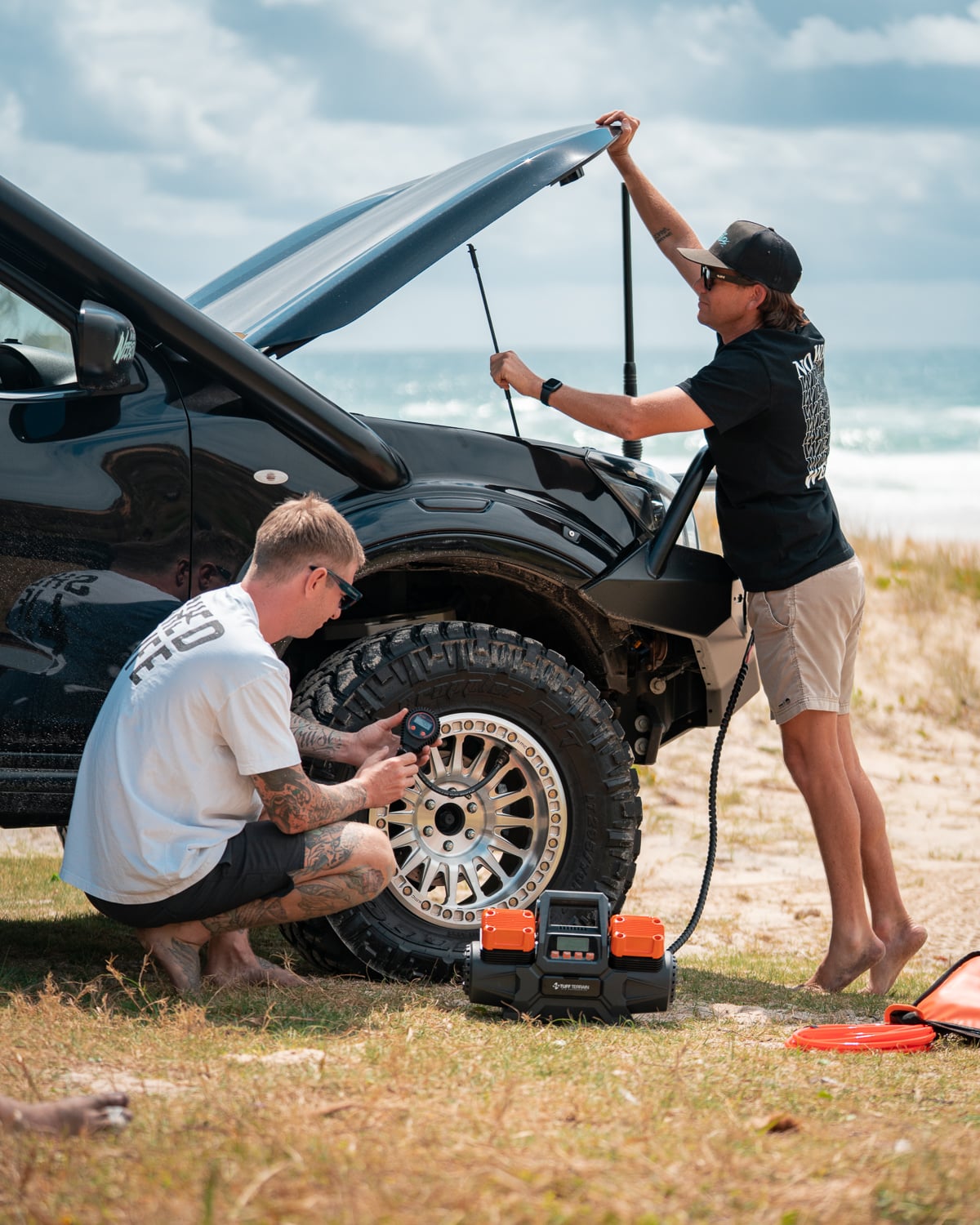
Equally important is tyre pressure management – a critical factor in off-road capability. Before tackling sand or technical terrain, TJ & Mac routinely air down using Tuff Terrain air systems, and rely on Tuff Terrain compressors to reinflate tyres quickly and efficiently once they’re back on harder ground. It’s a simple but essential part of off-road touring, and one that demonstrates the importance of reliable equipment.
Their builds frequently centre around some of Australia’s most popular touring platforms, including the Toyota Hilux, Toyota LandCruiser and Ford Ranger. Rather than chasing extreme or unrealistic setups, TJ & Mac focus on practical modifications that deliver measurable improvements – suspension upgrades, recovery gear, and essential touring equipment that make vehicles more capable without sacrificing everyday usability.
One of the reasons their content resonates so strongly with the 4WD community is the way they document the entire process. Instead of presenting finished builds, they walk viewers through each stage – explaining the reasoning behind upgrade decisions, installation considerations and how different components contribute to overall capability.
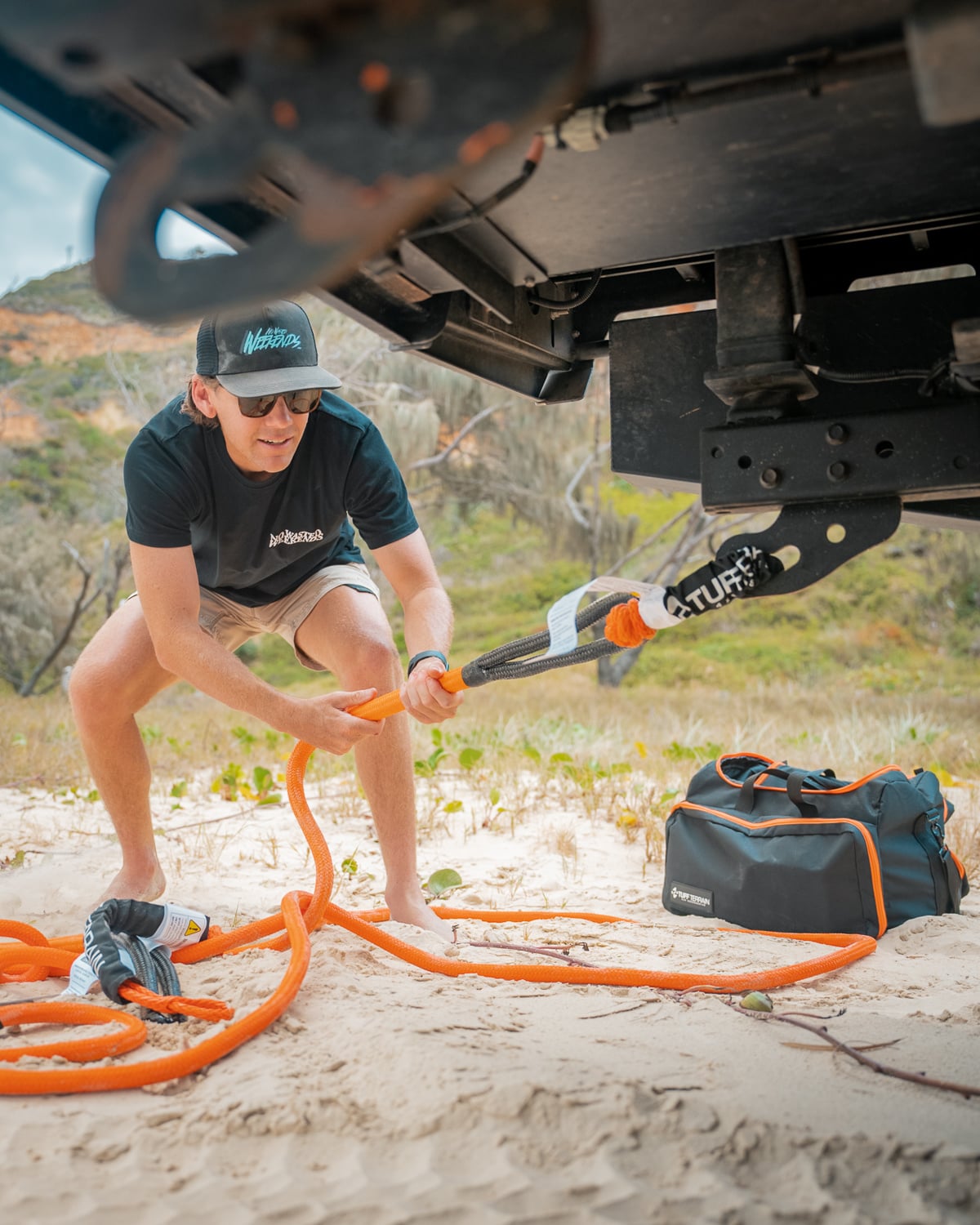
That hands-on approach naturally aligns with Tuff Terrain’s focus on engineered durability and real-world performance. Seeing the gear used in genuine off-road situations – from vehicle recoveries to tyre pressure adjustments before a track – gives viewers a clear understanding of how the equipment performs outside the showroom.
For the growing audience following TJ & Mac’s builds and adventures, the takeaway is simple: thoughtful upgrades and reliable equipment can transform a capable vehicle into a confident touring setup. And when those upgrades are tested in the real world, their value becomes clear.
As TJ & Mac continue to build, test and tour across Australia, Tuff Terrain gear remains a key part of their recovery and air management setup – proving that the right equipment doesn’t just support the vehicle, it supports the entire adventure.
Maddy Bockett is an Australian content creator and outdoor personality known for blending 4×4 adventure, gear insights and lifestyle content.
With around 128k followers on Instagram and 152k on TikTok, Maddy Bockett speaks authentically to a predominantly female audience about vehicle preparation, outdoor setups and getting the most out of touring gear. Her content focuses on making 4×4 and camping setups approachable, with fun, easy-to-follow guides that encourage confidence without overcomplicating the process.
A key feature of Maddy’s content is her Suzuki Jimny, which she regularly showcases through upgrades, packing strategies and setup optimisation for real road trips and camping experiences. Rather than focusing on extreme builds, her approach centres on how thoughtful configuration and quality gear can improve comfort, usability and capability for touring and outdoor use. This makes her content highly relevant to everyday adventurers planning practical trips around Australia.
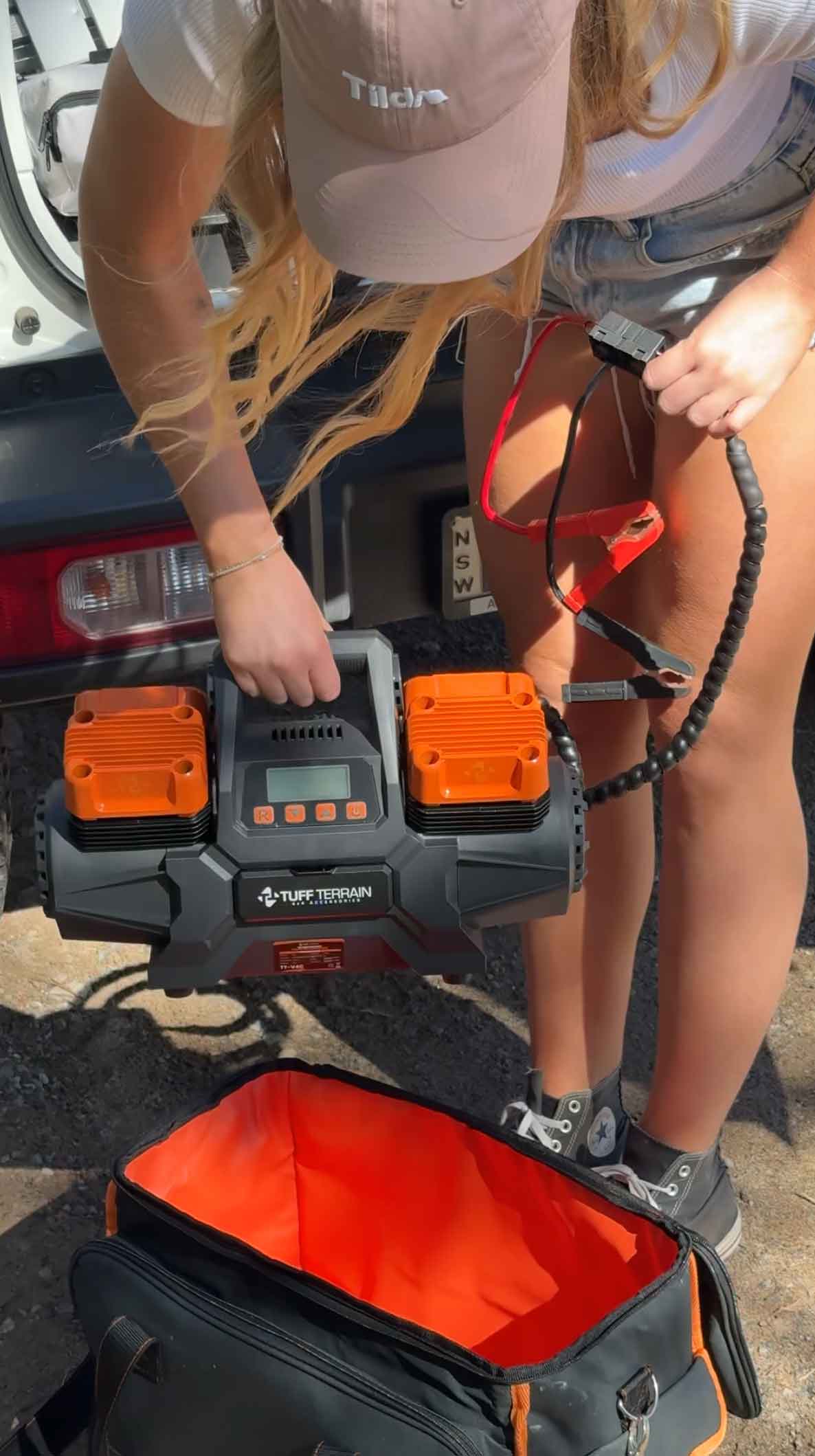
Maddy’s work aligns closely with Tuff Terrain’s brand pillars. She demonstrates built-for-Australia performance by showcasing gear on genuine Australian road trips and camping runs. Through real-world use, she highlights engineered toughness, showing how vehicle upgrades and accessories perform outside controlled environments.
Her content delivers real-world credibility, grounded in practical preparation and clear use-case demonstrations. Most importantly, her approachable delivery reinforces accessibility, helping a broad outdoor audience understand how to set up their vehicles and gear with confidence.
For Tuff Terrain customers, Maddy Bockett’s content shows how the right gear supports real adventures – practical, achievable and designed for the way Australians actually travel.
A proper recovery kit is an essential piece of gear for any 4×4 enthusiast, and Tuff Terrain offers a selection of kits to suit different levels of off-road ambition.
Off-road travel exposes vehicles to sand, mud, rocky terrain and steep tracks, and even the most capable rigs can become stuck or encounter obstacles. A recovery kit gives drivers the tools to manage these situations safely and efficiently, without improvising under pressure.
Straps, shackles, ropes, tree straps, winch accessories, and tyre deflation tools are all critical, and having them organised and accessible can make the difference between a smooth recovery and a stressful, risky situation.
Tuff Terrain Bush Kit Lite
The Tuff Terrain Bush Kit Lite is a compact, practical recovery kit for new and casual 4x4ers, providing all the essential tools for safe off-road recoveries without unnecessary complexity.
Designed for bush and beach use, it brings together straps, shackles, a winch ring, and a dampener into a single organised bag, keeping gear protected, easy to access, and ready for immediate use. Every component is load-rated to suit vehicles within their specified working limits, giving confidence in standard recovery scenarios.
Safety and efficiency are at the core of the Bush Kit Lite. Soft shackles, a recovery hitch, gloves, and a winch dampener reduce the risk of injury and equipment damage, while the organised bag eliminates fumbling or misplacing items. Lightweight and compact, the kit stores easily in most vehicles, making it ideal for weekend trips, touring, or spontaneous off-road adventures.
Tuff Terrain Bush Kit Pro
The Tuff Terrain Bush Kit Pro is a professional-grade recovery kit built for serious off-road enthusiasts.
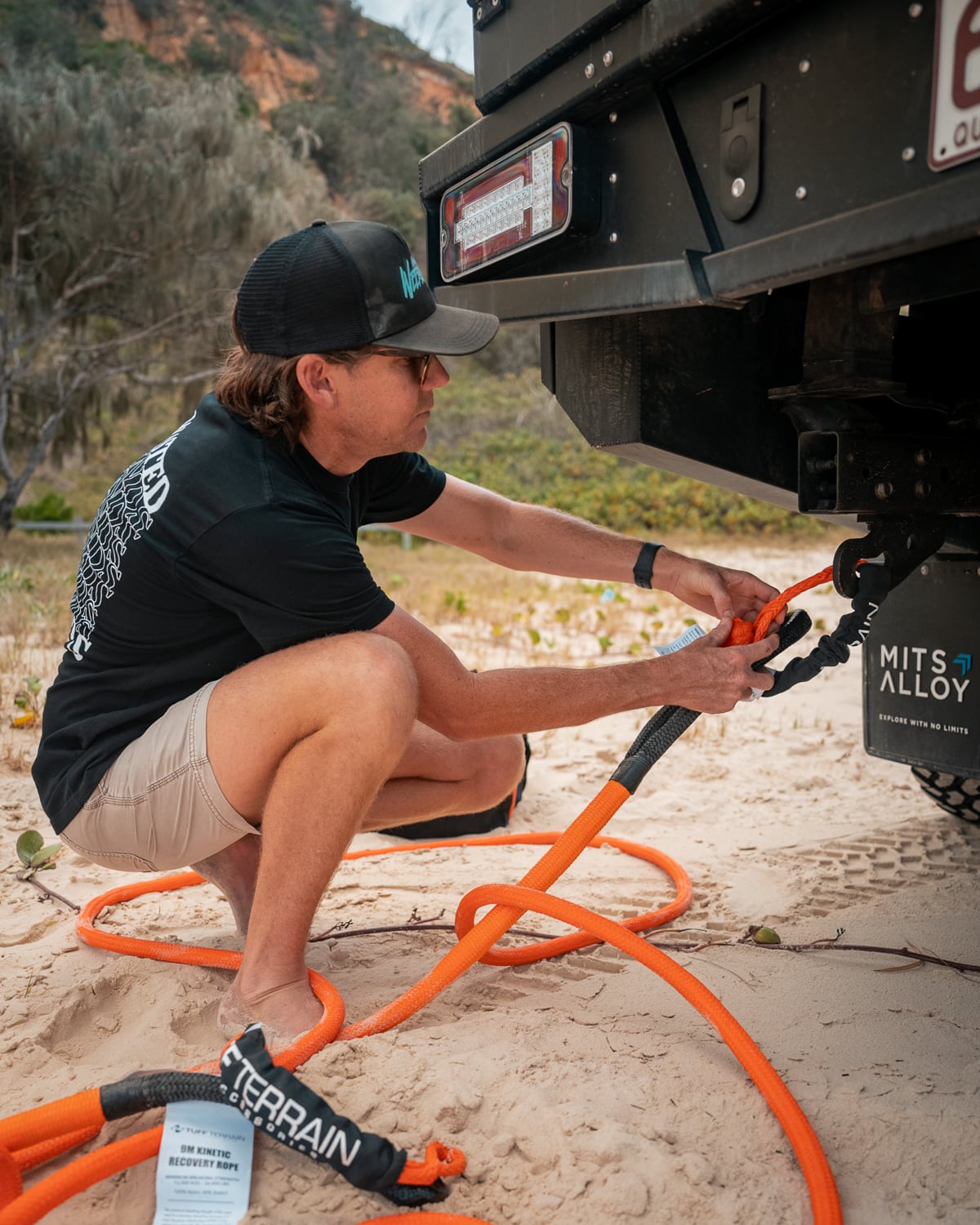
Designed to handle everything from soft recoveries to full winching operations, it combines premium-rated straps, ropes, shackles and winch accessories in a single heavy-duty package. Packed into a rugged recovery bag, all components are organised for quick access, protected in transit, and ready for immediate use.
The kit includes multiple 17T soft shackles in sheathed and braided designs, a 9T kinetic rope, a 3m static rope, extension and tree trunk straps, winch rings, a winch dampener, recovery gloves, and a soft shackle recovery hitch. This combination covers a wide range of recovery scenarios, from simple pulls to complex triple-line winch operations. Each item is engineered for high load capacity, durability, and safe operation, while soft shackles and protective accessories reduce the risk of injury or equipment damage.
The Bush Kit Pro is ideal for use in sand, mud, rocky terrain, or remote bush tracks where preparation and reliability are critical. The organised heavy-duty bag keeps gear secure, easy to transport, and immediately accessible, removing the need to chase scattered equipment or compromise safety under pressure.
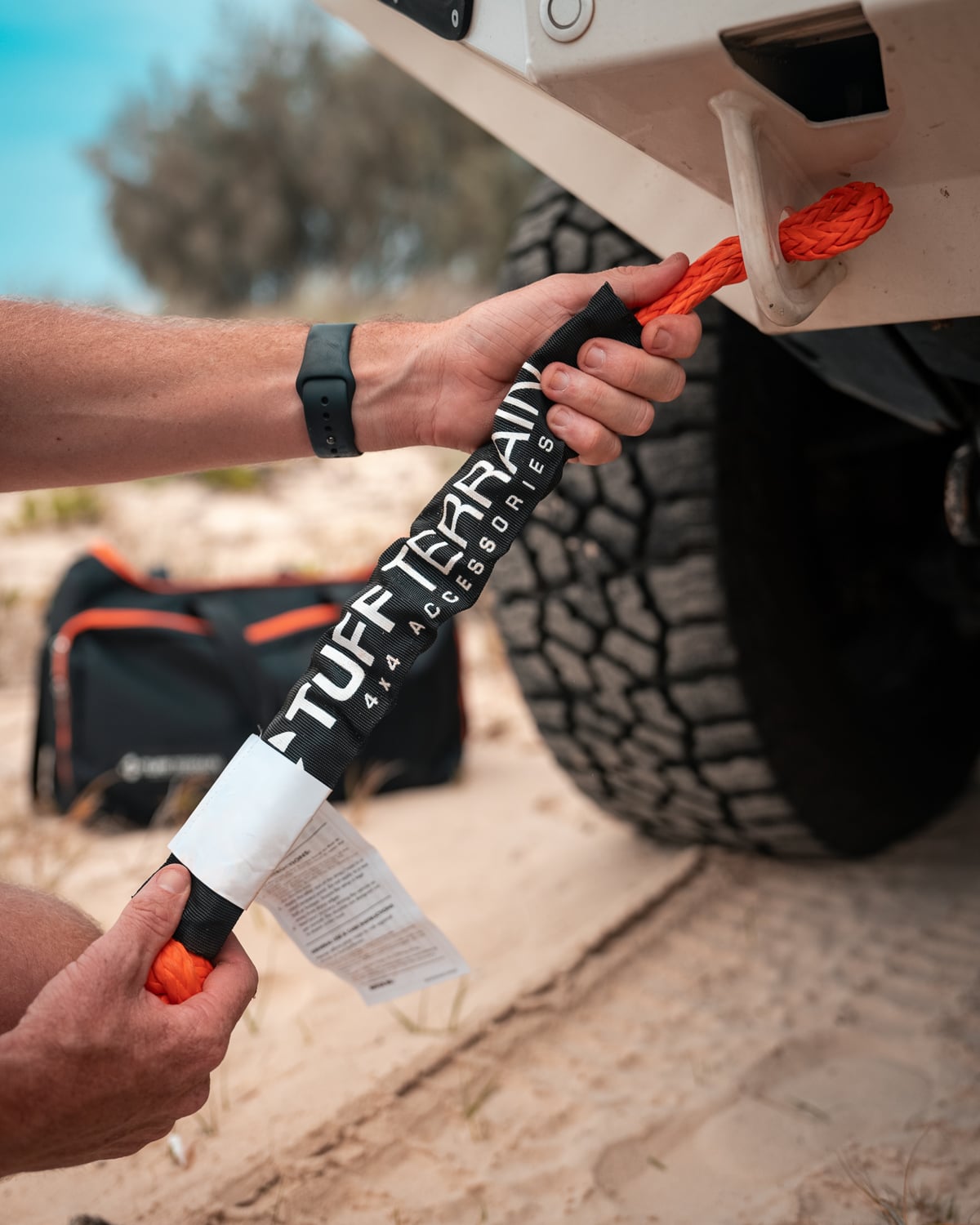
Tuff Terrain Deluxe 12K Recovery & Air Down Kit
The Tuff Terrain Deluxe 12K Recovery & Air Down Kit is a comprehensive solution for off-road drivers who want to manage two critical tasks in one package: Vehicle recovery and tyre deflation.
It combines ropes, straps, shackles and winch accessories with quick-connect tyre deflators, allowing drivers to prepare for challenging terrain and handle recoveries efficiently. All items pack into a single heavy-duty bag for easy transport and immediate availability.
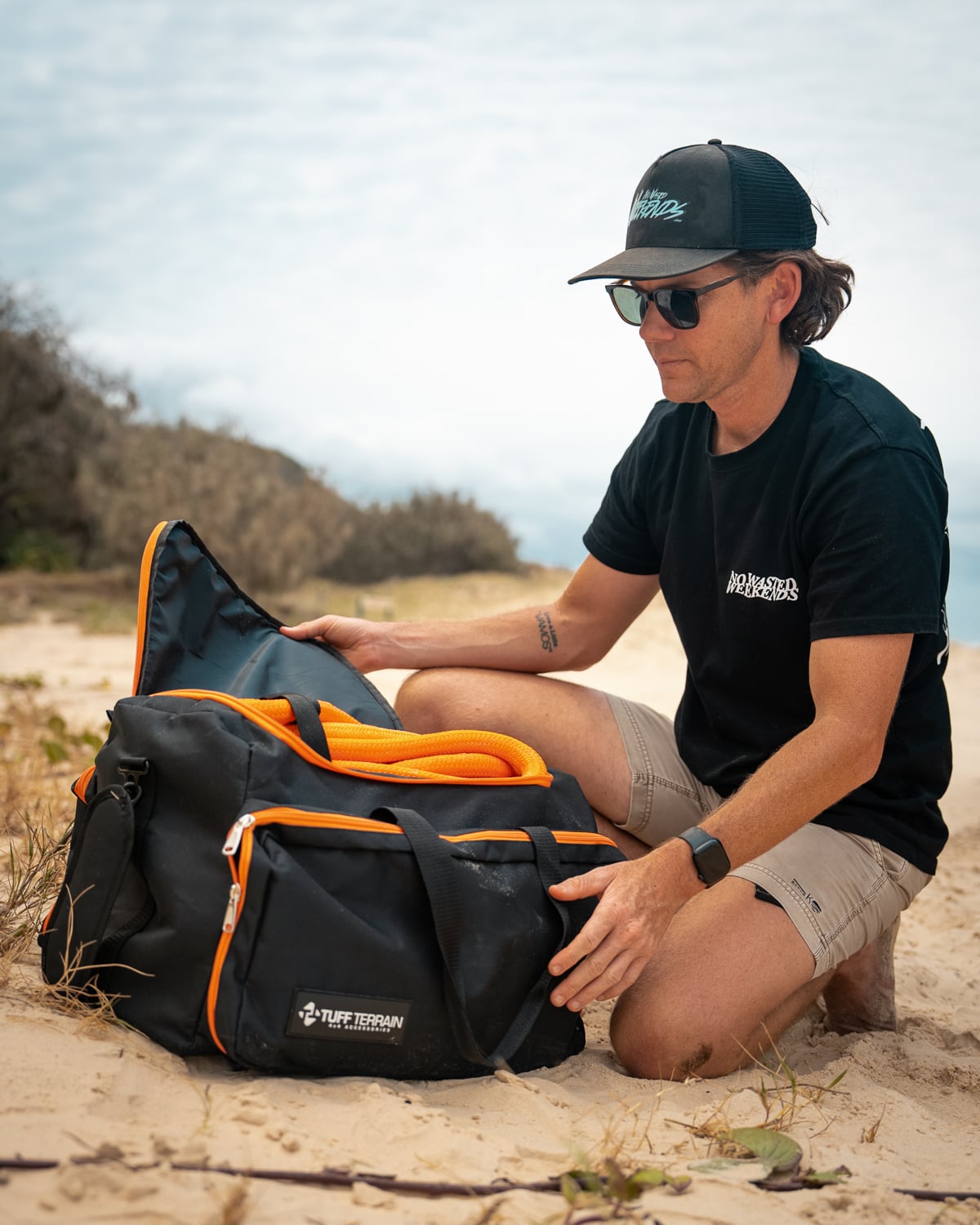
For recovery, the kit includes a 9m 12,000kg kinetic rope for snatch pulls, providing controlled stretch to store and release energy smoothly, and a 3m 28,900kg static rope that maintains firm tension for bridging or extending anchor points. Five soft shackles rated at 15,000kg, in sheathed and braided designs, allow fast, lightweight connections without the weight or sharp edges of metal shackles.
An alloy winch ring helps redirect ropes and can double pulling power, while a recovery hitch provides a smooth attachment point for soft shackles. Supporting accessories include a 12T tree trunk strap, a 5T extension strap, a winch dampener, and recovery gloves.
The air-down component features four quick-connect tyre deflators with preset pressures, enabling consistent and precise tyre deflation for sand or soft terrain. Combining recovery and tyre preparation gear in one organised kit reduces setup time and ensures drivers are equipped for common off-road challenges.